
WHAT makes Luis Antonio Tagle’s appointment as Cardinal-Bishop significant in Church History as whole?
By Rancho Arcilla
12 May 2020
Social media and the press have been abuzz over the past weeks regarding Antonio Luis Tagle‘s new appointment at the Vatican. He is now a Cardinal-Bishop of the Holy Roman Church. Obviously he is the first Asian in modern times to get this title. But beside this being an achievement for racial equality, what makes this appointment exceptional for the Catholic Church’s long history as a whole?
Due to an ancient tradition that goes back to the middle age, all cardinals of the Roman Catholic Church are attached to titular churches under the Diocese of Rome. It can be said that the essence of a cardinal’s title is bound to their relationship with their titular Roman church, and as such, a bishop cannot assume the cardinalate unless he is bound to Rome. All cardinals, regardless of nationality, are therefore all titularly “Roman” clergymen.
While a class of their own, cardinals are actually divided into three ranks:
- Cardinal-Deacon;
- Cardinal-Priest; and
- Cardinal-Bishop.
Under this system, bishops are either promoted as titular cardinal-deacons or titular cardinal-priests in one of the parishes of Rome. The most prominent, however, are assigned as cardinal-bishops to the seven Suburbicarian Dioceses.
The Seven Suburbicarian Dioceses of Rome are as follows:
- Ostia;
- Albano;
- Frascati;
- Palestrina;
- Porto-Santa Rufina;
- Sabina-Poggio Mirteto; and
- Velletri-Segni.
The Cardinal-Bishop of Ostia, considered as the most prominent of all, is also always the Dean (or head) of the College of Cardinals.
The first Filipino cardinal is, of course, Archbishop Rufino J. Santos of Manila who in 1960 at the age of 51 was created a cardinal-priest attached to the Church of Santa Maria ai Monti in Rome. Archbishop Jose Sanchez of Nueva Segovia is so far the only Filipino to be created a cardinal-deacon (attached to San Pio V a Villa Carpegna) before being promoted to the rank of a cardinal-priest (of the same titular church). In 2020 the Archdiocese of Manila scored another “first” when its archbishop, Antonio Luis Tagle, was created the first Filipino cardinal-bishop, another milestone since Cardinal Santos in 1960.
In all, the native clergy of the Philippines has produced a total of 8 cardinals: 1 cardinal-deacon, 8 cardinal-priests, and 1 cardinal-bishop. They are as follows:
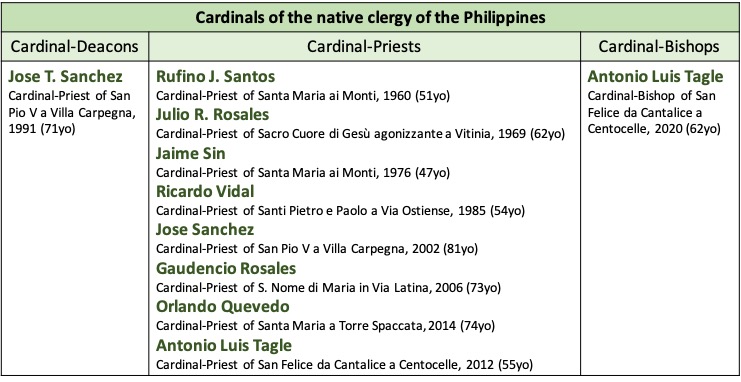
Jaime Sin was the youngest cardinal-priest at 47 years old, but unlike Tagle, he never went further his rank. But wait, isn’t it that cardinal-bishops are supposed to be assigned to one of the seven Suburbicarian Dioceses of Rome? Yes, this was tradition since the middle ages. For more than a millenium, there were only seven cardinal-bishops at any given time. Only seven.
When I first read the news about Cardinal Tagle’s new appointment, the first that I noticed was that no one bothered reporting about his titular Suburbicarian diocese, the essence of his appointment. Was it Ostia? Frascati? At first I thought it was another case of bad homework, then I realized the reason was far more profound than I initially thought: his titular church, San Felice da Cantalice, which was not Suburbicarian, was made and promoted to subarbarican status (albeit Pro Hac Vice) just for him. In legal parlance, Pro Hac Vice means “for this occasion.”
It may not seem much for the modern reader, but this is a break from more than 1,300 years of Church history. In 2018 when Pope Francis wanted more cardinal-bishops even in the absence of vacant Suburbicarian sees, he issued a historical document known as the Rescriptum Ex Audientia which promoted Parolin, Sandri, Ouellet, and Filoni as cardinal-bishops–all without attachment to the original seven Suburbicarian sees. In 2020, another cardinal-bishop was created without attachment to the original Suburbicarian dioceses: Luis Antonio Tagle of Manila. At present, out of the total cardinal-priests (174) and cardinal-deacons (35), there are only 11 cardinal-bishops–of these twelve, four are not traditionally Suburbicarian.
The Pope’s grace and favor over Luis Antonio Tagle is made more colorful, not only because of his Asian race, but also because of the extraordinary and historical circumstances which surrounded his appointment. While Luis Antonio Tagle’s appointment as cardinal-bishop reflects his merit as an outstanding clergyman, as well as society’s advances in racial equality and social mobility, it also reflects Pope Francis’ conviction as a shepherd for the changing times. Lastly and most important of all, while Cardinal Tagle is not the first cardinal-bishop with a pro hac vice suburbicarian see, one can confidently say that above all things, his appointment is a clear validation and a significant indicator of major changes deep within the heart of the Roman Catholic Church–changes not seen for more than a thousand years.

Photo from Wikimedia commons.
Note: By virtue of convention, the plural of cardinal-bishop is “cardinal-bishops,” not “cardinals-bishop.” Same rule applies to cardinal-deacons and cardinal-priests.
About the Author: Rancho Arcilla
John Paul Escandor Arcilla, known professionally as Rancho Arcilla, is the author of the Intramuros Register of Styles (2021). He served as Chairperson of the Intramuros Technical Committee on Architectural Standards (TCAS) from June 2022 to May 2024. As TCAS Chairperson, Arcilla oversaw the review of all development, including new constructions, in the Walled City.
Arcilla was also the first Archivist of the Intramuros Administration. With mandate from Atty. Guiller Asido, Administrator of Intramuros from 2017 to 2022, Arcilla established the Administration’s Archives and Central Records Section, serving as its first Section Head from July 2019 to June 2024.
He has an MA in Philippine Studies from UP Diliman and a BA in Asian Studies from the University of Santo Tomas. Arcilla specializes on colonial architecture. In 2021, Arcilla was instrumental in the development of the Revised 2021 Implementing Rules and Regulations (IRR) of Presidential Decree No. 1616, the main framework and legal instrument in the management of Intramuros District. The architectural provisions of the IRR and the Intramuros Register of Styles (2021) is based on his MA thesis Walls within Walls: The Architecture of Intramuros (2021).
References
Sägmüller, J.B. (1908). Cardinal. In The Catholic Encyclopedia. New York: Robert Appleton Company. Retrieved May 12, 2020 from New Advent: bi t. ly/ 3ctfFCc
Holy See Press Office (2018). Rescriptum Ex Audientia. Retrieved from bi t. ly /2SYc6vX
Catholic Hierarchy (n.d.) Cardinal-Bishops. Retrieved from bi t. ly /3fJISdS
 Renacimiento Manila
Leave a comment