

Trivia no. 11: Things that are younger than Manila
By Renacimiento Manila
18 June 2020
Manila’s age from the time of its re-establishment as a Spanish colonial city in 1571 is sometimes difficult to appreciate since it’s something you don’t think of everyday. This year it’s already 449 years old. But what does the figure 449 mean? One can think of it either as a century multiplied by four plus 49, or in terms of number of generations which could mean a lot depending on how one counts. Another way of doing it, however, is by association or comparison. Manila is a historical city, and a great way of appreciating its longevity while understanding its history is by comparing its age with other known milestones in global history.
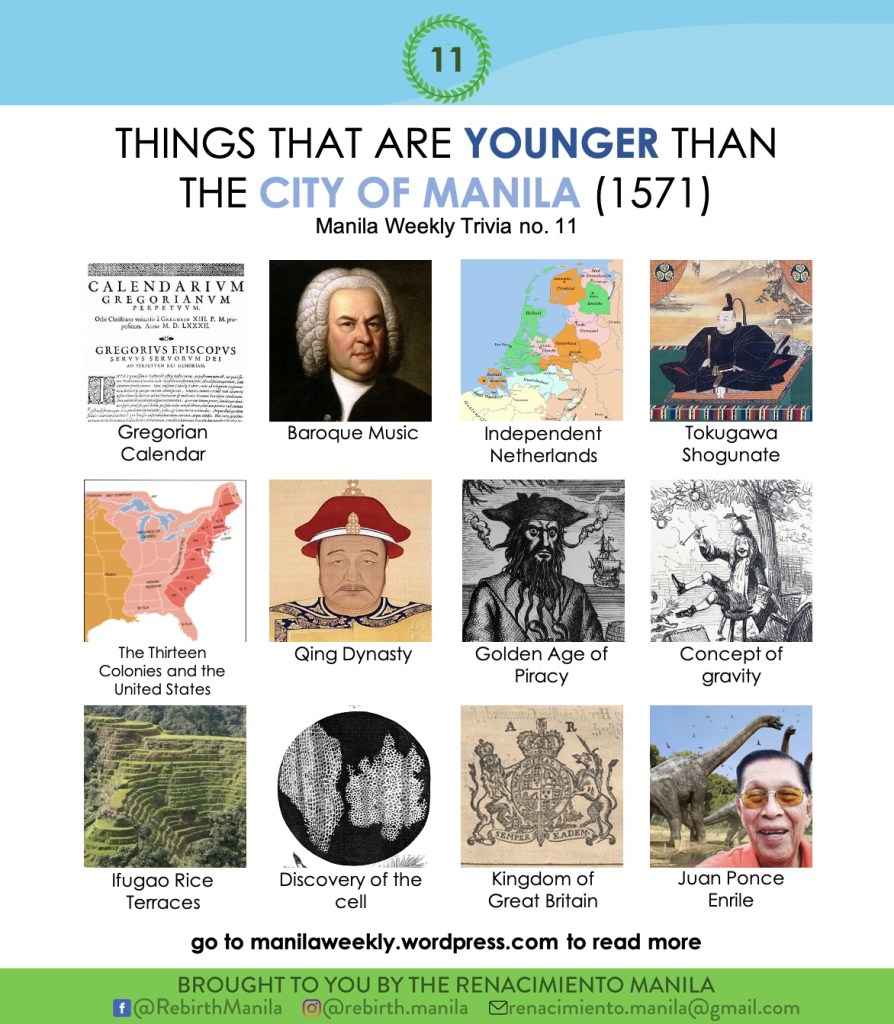
But before we proceed it is important to recognize that Manila as a sovereign and independent polity already existed long before Spanish conquest. 1571 is thus only a marker on when it was transformed as a capital for Spain’s colonial empire in the Far East. It is certain that Manila is older than more human events in world history, however, for the purpose of this article, we shall be focusing on the year 1571 as the starting point.
Baroque Music (1580)

When the United States occupied the Philippines in 1898, popular music in the US was characterized by marches, vaudeville, barbershop quartets, opera, novelty songs, and other popular tunes. However, when Spanish conquistadors first occupied Manila in 1571, the Europeans would have been listening to Renaissance Music. It was not until 1580 when the earliest form of Baroque Music first emerged in Europe.
Gregorian Calendar (1582)
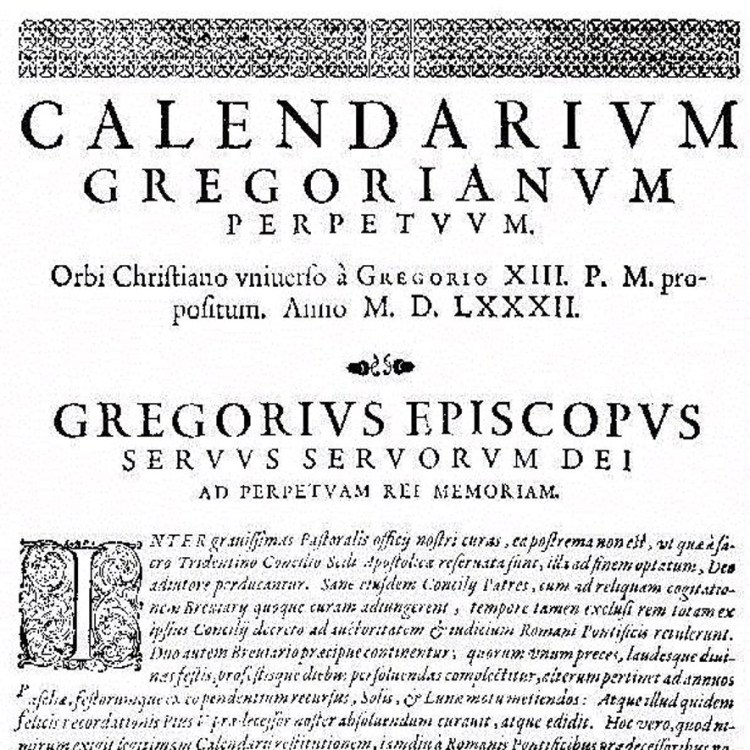
Spanish Manila was already 11 years old when the Gregorian Calendar was first introduced by Pope Gregory XIII in 1582. Before this point the Julian Calendar (first introduced by Julius Caesar in 46 B.C.) was used in Europe and in her colonies. The Gregorian Calendar is now the dominant calendar in modern times.
Independent Netherlands (1588)
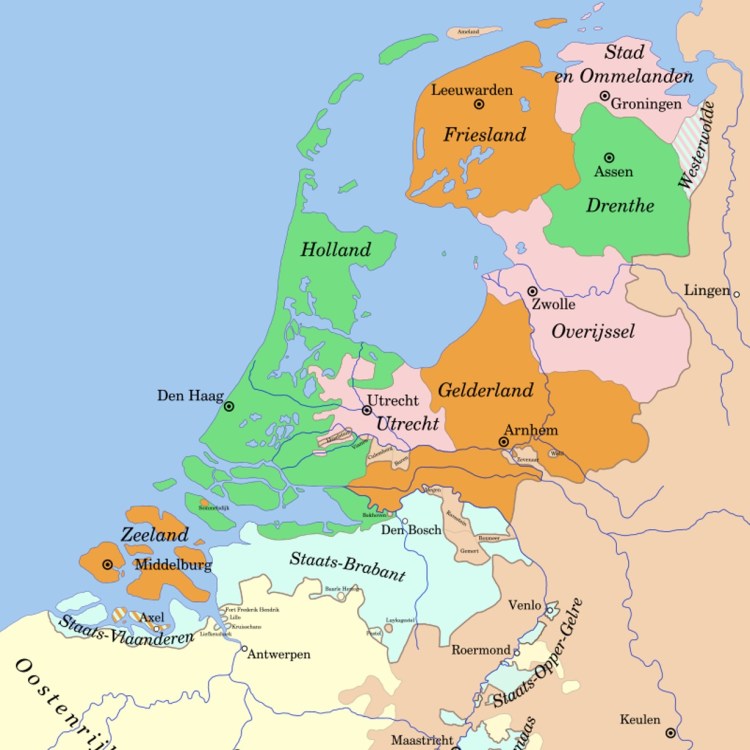
The Netherlands, or the Low Countries, was previously a Spanish possession before declaring independence in 1588 as a separate sovereign nation known as the Dutch Republic. The Dutch War of Independence lasted from 1568 to 1648, and Manila being a Spanish colonial city, was dragged into the conflict as well. In April 13, 1617, a Dutch naval fleet attempted to enter Manila Bay but was subsequently defeated by combined Spanish and native Indio forces led by Juan Ronquillo. Decisive encounters and more intense battles occurred in 1646 when the Dutch attempted to invade Manila again. Against all odds, the Spanish — undoubtedly with Indio sailors and crew — won in a series of encounters from March to October that year. The Archbishop of Manila declared the victories miraculous, thereby beginning the feast of “La Navál de Manila” which continues even to this day.
Tokugawa Shogunate (1603)
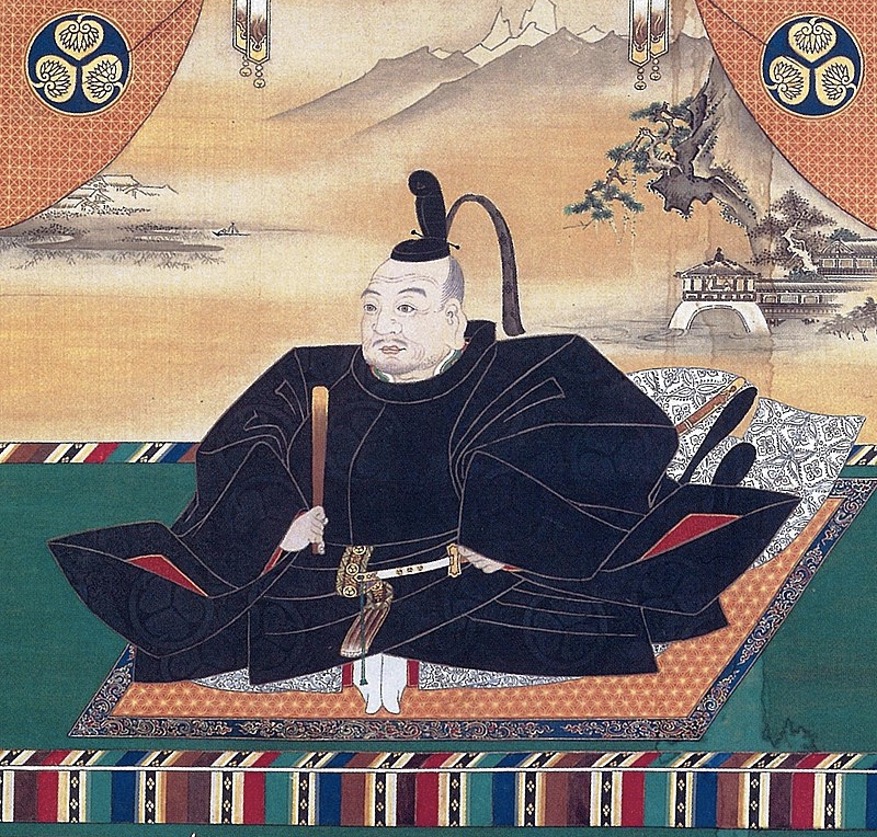
Manila served as a springboard for European missionary activities in Asia. While the Philippines was being brought under the cross, the ultimate goal was the evangelization of China and Japan. As such, missionaries would often stop over first in Manila before proceeding to the rest of the continent. When Manila was re-established as a Spanish city in 1571, Japan was actually still under the Ashikaga shoguns. It was not until 1603, when Manila was already 32 years old, when the Tokugawa Shogunate was established by Tokugawa Ieyasu. By this time Manila’s stone walls were already completed, and the San Agustin Church was already under construction.
The Thirteen Colonies (1607)
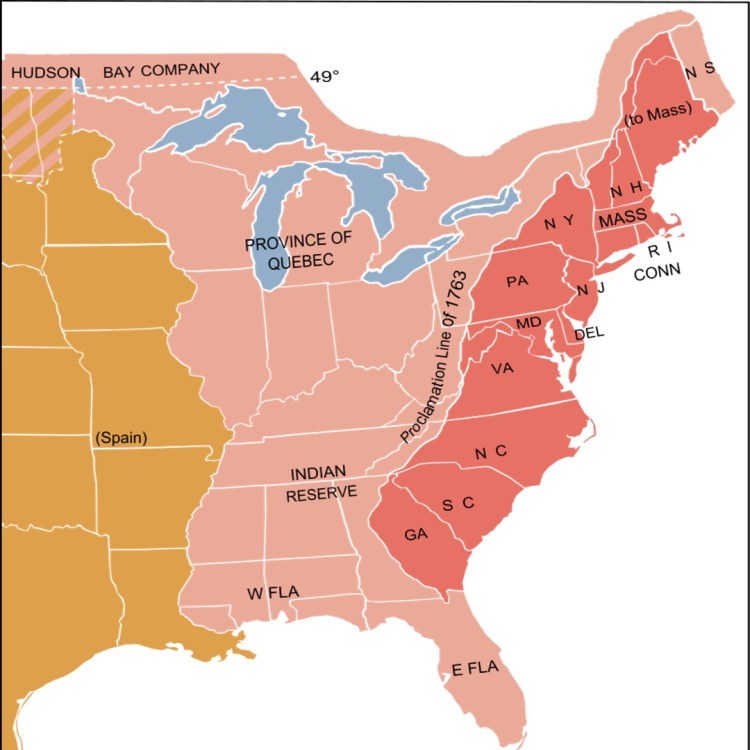
The United States took over Manila from Spain in 1898 and from then on treated the local population as savages that needed pacification and education. The ironic part, however, is the fact that they took over a city that was even older than their civilization. When the Thirteen Colonies, the predecessor of the modern United States, was first settled by the English in 1607, Manila already existed for 36 years. While the Thirteen Colonies was the backwater of North America, Manila was already a bustling city at the crossroads of civilization connecting Asia with the New World, and by extension Europe. By the time the Thirteen Colonies gained independence as the United States of America, Manila was already 206 years old!
Qing Dynasty (1644)

Through trade, Manila has a long history with mainland China. However, when Manila was conquered by the forces of Miguel Lopez de Legazpi in 1571, the city was still trading with Ming citizens. Thus Manila is contemporaneous with the Mings. By the time the last Ming emperor was overthrown and the Qing (or Manchu) Dynasty was established in 1644, Spanish Manila was already 73 years old. By this time Manila was already well established, the walls have been completed, almost all structures were already in stone, and the churches were already well founded.
Golden Age of piracy (1650)
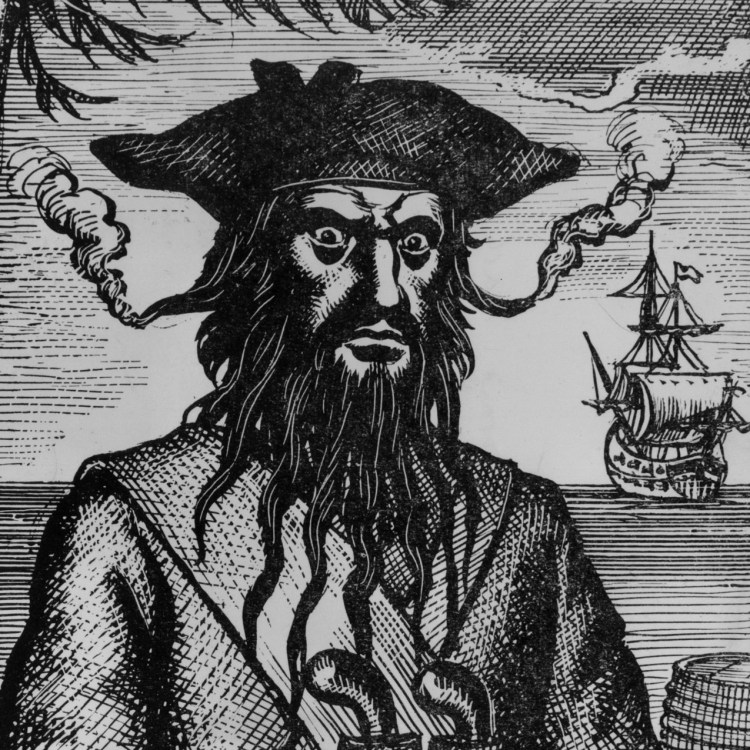
Pirates have existed since ancient times, but the Golden Age of Piracy spanned from 1650 to 1720. By the middle of this age, Manila was already more than a hundred years old. But pirate attacks on Manila did not begin in the 17th Century as Manila was already ravaged by pirates since its earliest beginnings. It should be noted that pirates are one of the reasons why the walls of Manila existed in the first place. The worst attack came in 1574 when Manila was invaded by Limahong (林鳳). As a direct consequence, the walls of Manila have been rebuilt in stone.
Modern concept of gravity (1687)
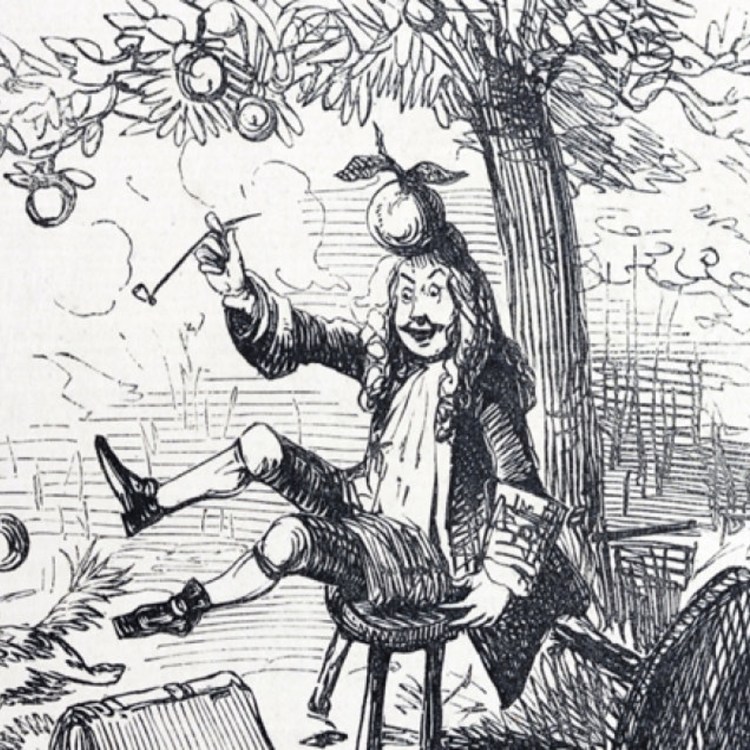
The modern concept of gravity as we know it today largely comes from Isaac Newton’s Law of Universal Gravitation which was published under his Philosophiæ Naturalis Principia Mathematica in 1687. By this time, Spanish Manila was 116 years old. What then was taught in Manila schools? Schools such as Santo Tomas, San Ignacio, and San Jose started as seminary colleges, and their curriculum would have focused on theology, philosophy, and the Greek classics. Secular degrees such as Law, Medicine, and Pharmacy did not appear until centuries later.
Discovery of the Cell (1665)

The cell is the smallest unit of life and is basic in the understanding of biology. However, it was only in 1665 when Robert Hooke was the first to ‘discover’ the cell using an early version of the compound microscope. Before modern medicine, Manila like the rest of the world relied on pre-modern science. Healthcare and the understanding of biology was different during Manila’s early days. However, this did not mean that Manila lagged in terms of public health. In fact, Manila’s public health care during the Spanish colonial regime was perhaps much better than those found in most countries in Asia and at par with many other countries in the world. True enough, by the end of the 16th Century, Manila in fact have had several functioning hospitals: Hospital Real de Españoles (1577-1898), Hospital de la Misericordia (1578-1656), Hospital de los Indios Naturales (1578-1603), the Hospital de San Gabriel (1587-1774), and the Hospital de San Juan de Dios (1656-Present), among others.
The Rice Terraces (17th Century)

It is commonly believed the Rice Terraces in Ifugao is more than 2,000 years old. However, a group of scientists led by Stephen Acabado from UCLA has presented evidence disputing this long-held belief. Firstly, the 2,000 year old dating was merely the product of guesswork and was devoid of science. The original proponent, Henry Otley Beyer, came up with their guesswork by speculating how long it would have taken the Ifugao to construct the terraces. Secondly, it was concluded and verified by historical sources and radiocarbon data that the construction of the Rice Terraces was actually a direct response to Spanish colonization when the local population was forced to go up and settle in the highlands to escape the Spaniards. A more detailed explanation may be read at bit. ly /2Zas9sH. It is difficult to set the construction of the Rice Terraces at a specific date or year, but it is interesting to note that by the time of its first appearance as a consequence of colonialism in the mid 17th Century, Manila was already well established as a cosmopolitan city.
Kingdom of Great Britain (1707)
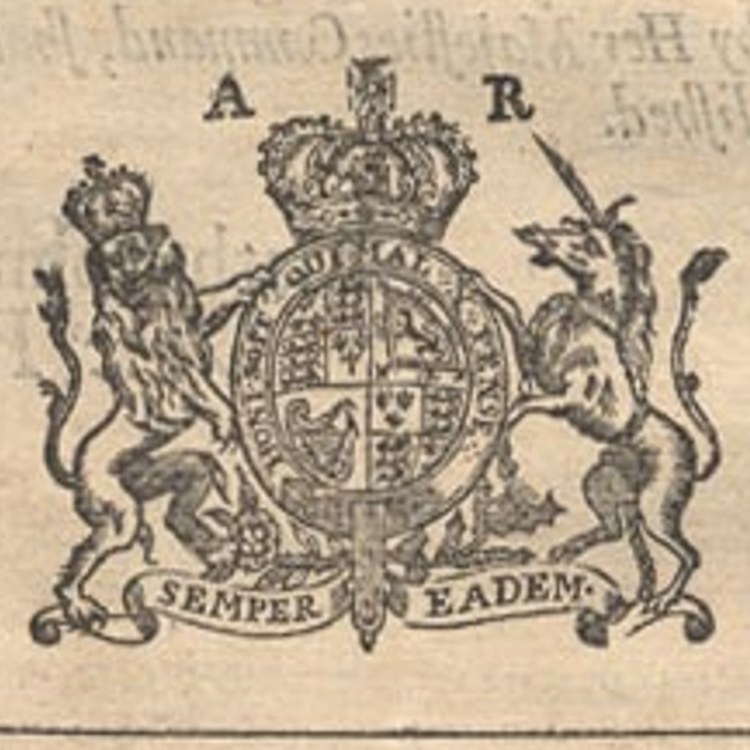
In 1571 England and Scotland were separate kingdoms ruled by separate sovereigns, parliaments, and laws. Its monarchy was united in 1603 when the King of Scotland, James VI, succeeded Queen Elizabeth to the throne of England as James I. However, the two nations remained independent. This setup continued until the reign of Queen Anne when she became the first queen of a single Great Britain. During the Seven Years war it was not Kingdom of England, but rather the Kingdom of Great Britain that invaded and looted the City of Manila for two years from 1762 to 1764.
Juan Ponce Enrile (Immortal)

Former senator Juan Ponce Enrile is perhaps one of the most “memed” politician these days. A March 2020 article from Esquire Magazine even joked that he would probably outlive us all. He “might” have seen dinosaurs. Despite his celestial age, the fact remains that Manila is still older than Juan Ponce Enrile.
REFERENCES
Acabado, Stephen., et. al. (2019, Apr 14). Demystifying the age of the Ifugao Rice Terraces to decolonize history. Rappler. Retrieved 26 Jun 2020 from bit. ly /2Zas9sH
Cohen, Jennie. (2012, Sep 13). 6 Things You May Not Know About the Gregorian Calendar. History. Retrieved 25 Jun 2020 from bit. ly /3dzLR6z
Encyclopedia Britannica (nd.a). Tokugawa Period. Retrieved 26 Jun 2020 from bit. ly/ 3g2sNiG
Encyclopedia Britannica (nd.b). Qing Dynasty. Retrieved 26 Jun 2020 from bit. ly /2Bc64Cb
Inchimura, Anri. (2020, March 24). The Best Enrile Immortality Memes Of All Time. Esquire Magazine. Retrieved 25 June 2020 from bit. ly /3hXjDGl
Jha, Alok. (2013, Oct 13). Newton’s Universal Law of Gravitation. The Guardian. Retrieved 25 Jun 2020 from bit. ly/ 31hmnbq
Laskow, Sarah. (2015, Dec 30). In 1844, the Philippines Skipped a Day, And It Took Decades for the Rest of the World to Notice. Atlas Obscura. Retrieved 25 Jun 2020 from bit. ly/ 31hKYx4
Laya, Jaime. (2009, Oct 11). Wala Lang: When we got caught in between: ‘La Navál de Manila.’ Manila Bulletin Publishing Corporation. Retrieved 26 Jun 2020 from bit. ly /2Nx7jyq
Medina, Marielle. (2018, Apr 13). Did you know: Foiled Dutch invasion of Manila. Inquirer. Retrieved 26 Jun 2020 from bit. ly /3dFsj0l
National Geographic. (n.d.). History of the Cell: Discovering the Cell. Retrieved 26 Jun 2020 from bit. ly /3ewX60K
Onnekink, David. (n.d.) The Dutch Republic. Gale. Retrieved 26 Jun 2020 from bit. ly /3dyKEMQ
Ranada, Pia. (2015, Apr 29). Ifugao Rice Terraces may be younger than we think. Rappler. bit. ly /2CANyUi
Roberts, H. Armstrong. (2010, Jun 17). The 13 Colonies. History. Retrieved 25 Jun 2020 from bit. ly /2VipNac
Royal Museums Greenwich. (n.d.) The Golden Age of Piracy. Royal Museums Greenwich. Retrieved 25 Jun 2020 from bit. ly /2Nvet6s
The Parliament (n.d.). Act of Union 1707. Retrieved 26 Jun 2020 from bit. ly /2NzcJZD
PHOTO SOURCES
For Gregorian Calendar: Wikimedia Commons. First page of the papal bull Inter gravissimas. Retrieved 25 Jun 2020 from bit. ly /31fdm2L
For Baroque Music; Wikimedia Commons. Johan Sebastian Bach. Retrieved 25 Jun 2020 from bit. ly /2Yx74cT
For The Netherlands: Wikimedia Commons. Photo retrieved 26 Jun 2020 from bit .ly /31iZhRP
For Tokugawa Shogunate: Wikimedia Commons. Portrait of Tokugawa Ieyasu. Retrieved 26 Jun 2020 from bit. ly /2BHKnJY
For the Thirteen Colonies: Wikimedia Commons. The Thirteen Colonies (shown in red) in 1775. Retrieved 25 Jun 2020 from bit. ly /2Vef7cA
For Qing Dynasty: Wikimedia Commons. Portrait of Hong Taiji (1592-1643). Retrieved 26 Jun 2020 from bit. ly/ 3g3YQ1I
For Golden Age of Piracy: Minster, Christopher. (2019, Apr 22). Blackbeard: Truth, Legends, Fiction and Myth. ThoughtCo. Retrieved 25 Jun 2020 from bit. ly /2Vkp4oT
For Concept of gravity: Roos, Dave. (n.d.) 10 False History ‘Facts’ Everyone Knows. How Stuff Works. Retrieved 25 Jun 2020 from bit. ly/ 3dx5fB7
For the Rice Terraces: Wikimedia Commons. Banaue rice terraces (N. Luzon, Philippines) taken from observation point at beginning of road to Bontoc. Retrieved 26 Jun 2020 from bit. ly/ 2Nxz75O
For the Discovery of the Cell: Wikimedia Commons. Drawing of the structure of cork by Robert Hooke that appeared in Micrographia. Retrieved 26 Jun 2020 from bit. ly/ 2Nwx95B
For Kingdom of Great Britain: Wikimedia Commons. Articles of Union. Retrieved 26 Jun 2002 from bit. ly/ 2ZaCKnI
For Juan Ponce Enrile: Malacañang Events and Catering Services. Twitter (2019, Apr 04). Retrieved 25 Jun 2020 from bit. ly/ 31guiG8

 Renacimiento Manila
Leave a comment