
Jeremiah M. Inocencio
Sept. 16, 2020
Marketplaces are one of the many important establishments that support and sustain the life of a neighborhood. It is where the residents buy everyday essentials and form bonds with their neighbors as well as with their “suking tindahan” or merchants who run businesses to earn their keep. One could take for its environment as noisy and sometimes, unkempt. But behind the seeming clutter, it is abound with stories coming from all walks of life, starting from every manang and manong to their suking mamimili. Marketplaces are one of the spaces that bind the soul of a community.

Source: John Tewell (Flickr).
Back in time where Manila’s waterways were actively used in trade and commerce, markets and commercial buildings sprang by the banks of these esteros and rivers. During the Spanish occupation, the Aduana and Alcaiceria were once located by the banks of Pasig River. And so were the boats and merchant steamers that unloaded goods from which Escolta, the then bustling commercial center of old Manila, thrived; and Quinta, the wet and dry market of Quiapo where one can find an abundance of native goods and wares. Cascos, small boats, and bamboo rafts rowed the length of Estero de Binondo to drop goods at Divisoria, the go-to place between Tondo and Binondo.
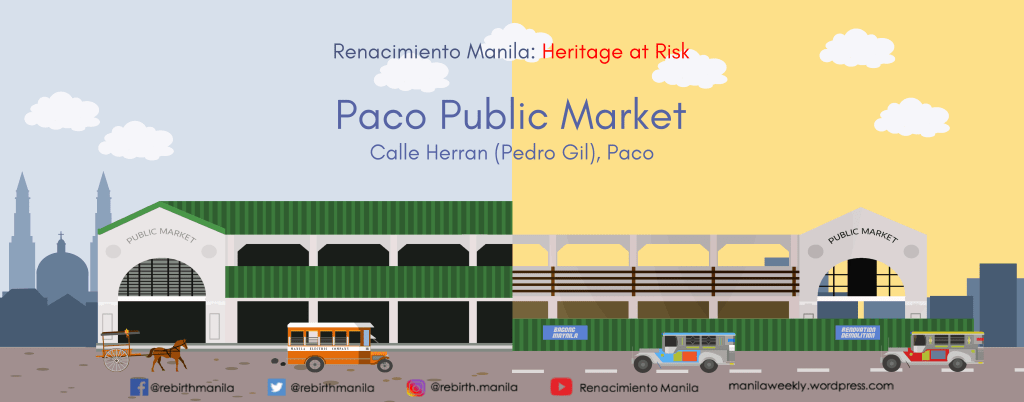
When he was commissioned by the American government in the Philippines, Architect Daniel Burnham affirmed the use of the city’s canals as an avenue of trade when he drew up his improvement plan for Manila in 1905. Among his recommendations for the City Beautiful plan were the improvements of public structures that would conform with the needs of the time, including health and sanitation. Some of his plans were executed and this includes the Paco Public Market. It featured the Mission Revivalist style as designed by Architect William Edward Parsons who also designed numerous historical buildings such as the pre-war Manila Hotel, Philippine Normal School, Philippine General Hospital, Elks Club, Army and Navy Club, and the nearby Paco Railway Station.

Source: Wikimedia Commons
Opened on May 1, 1912, the market was strategically located along Calle Dart (now Angel Linao Street) and Calle Herran (now Pedro Gil Street), one of Paco’s main thoroughfares while its other side faced Estero de Paco, a tributary of Manila Bay and Pasig River which the fishermen used to deliver their fresh catch. Its design, characterized by the use of concrete and steel trusses as well as large openings and a high ceiling which can accommodate natural light and adequate ventilation, became a standard for other public markets across the archipelago years later.
Paco Public Market is one of the oldest existing marketplaces in the country that was able to have its original structure and function preserved since its inception and even after World War II, up until the 21st century.
However, rapid industrialization and urbanization caused its features as well as the estero to be dilapidated and polluted. Domestic waste dumped on the canal obstructed the water flow and also led to the decline of the water quality. This went on until cleanup and rehabilitation projects were launched by the government and partners from the private sector. The destructive aftermath of Typhoon Ondoy in 2009 pushed the Pasig River Rehabilitation Commission to double its efforts in cleaning the estero. It was gradually transformed from a scenery of filth into a sanctuary of greenery as plants and repairs were put along its banks. In 2010, representatives from the Metropolitan Manila Development Authority, Local Government of Manila, Kapit Bisig para sa Ilog Pasig, and the volunteers and residents of Paco gathered to celebrate the successful cleanup of Estero de Paco.
To sustain this achievement, it was deemed necessary that the market should also be improved and rehabilitated. The rehabilitation plan included the restoration to its former appearance as well as the installation of environment-friendly fixtures. Activity spaces were also envisioned to be put up alongside organized vending stalls. In February 2010, then President Gloria Arroyo, Manila Mayor Alfredo Lim, and ABS-CBN Sagip Kapamilya Director Gina Lopez led the groundbreaking activity for the project which was expected to be complete in six months’ time. In June 2010, the Paco Market Redevelopment Project was finally launched with an estimated cost of Php 75 million, with a seed money of Php 15 million from the government. The initiative was supported by the City of Manila, Kapit Bisig para sa Ilog Pasig, Sonia Santiago-Olivares and Associates, and Rustan’s Group of Companies. It was finally inaugurated on April 7, 2011 with officials from the local and national government, ABS-CBN Corporation, and Rustan’s Group of Companies.
News about the proposed redevelopment of Paco Market that circulated just this past week drew various reactions from netizens, especially heritage advocates. It was revealed by the Center for Filipino Architecture through a Facebook post on September 10 that the market’s structure has been partially demolished, save only for its façade to give way for an alleged modernization project. The page called this practice as a form of facadism.
“If its walls could only talk, it will reprimand our generation for fetishizing surface over substance. We are witnessing the absurd urban trend in Manila in which the entirety of a historic building is demolished apart from the exterior façade to allow a new building to be constructed behind it,” a part of the post read.
In architecture, facadism is defined as the process of preserving or incorporating an old building’s “face” or façade while constructing a new building behind it.
“While the act of building a new structure behind a historic façade of Paco Market may seem benevolent and propped with good intention, facadism unleashes the sad truth about how we value our past and how we allow the money-centric political and market forces to hostage our beloved city.” The Center for Filipino Architecture’s post added.
The latest development is a new “town center” and will be led by Architect Ian de Leon who said in a post on his Facebook page that the building plans were approved by the “Historical Commission” and Manila’s building officials sometime around 2018 or 2019. An animated mockup of his design has been uploaded to his YouTube channel early this year. A Facebook page named “El Reportero” known for posting updates on heritage issues mentioned that National Historical Commission of the Philippines chairman Rene Escalante said that “his agency does not have any idea on the ongoing market renovation.”
NoliSoli.ph reports that the redevelopment includes the reassembling of the wet and dry section of the market, construction of another storey that will be occupied by a supermarket, coffee shops, and other spaces for commercial tenants.
“The modernist new look prominently features prominent roof structures propped by exposed beams and pillars as well as skeletal rectangular frames that seem to levitate in between peaks.” The article read.
Under Republic Act 10066 or the National Cultural Heritage Act of 2009, structures dating at least 50 years old, including Paco Public Market, shall be considered as an important cultural property unless declared otherwise declared by the pertinent cultural agency.
“Pride of place”, when interpreted in its literal and denotative meaning, describes that something is of prime value and of outstanding importance to the speaker. There are instances that this may or may not be receptive to our five senses. It can be tangible or intangible, as classified and described by the parameters of our cultural agencies. Regardless of whether it could be seen, felt, eaten, heard, or smelled, it is our generation’s duty to look after the patrimony bequeathed by our forebears to further enrich our appreciation for cultural and historical values. We must take on the path of the future by becoming wiser, for we carry with us the important lessons from the past.
Text by Jeremiah Inocencio
Illustration by Diego Gabriel Torres, Renacimiento Manila
All Rights Reserved.
References
blu print .o nem ega . com/ph-h istor ic-comme rcial-la ndmar ks/
news .abs- cbn. com/nation/02/22/10/pgma-leads-paco-market-restoration-groundbreaking
hear t-2-he art-on line. com/2011/04/07/paco-market-redevelopment/
archd aily . com/9 2966 7/faca dism- when-wa lls-talk -and-lie
relia nce-fo undry. com /blog /arch itectu ral-fa cadism #gref
nolis oli . ph/86 391/paco -market-mo dernist-red esign-heri tage- cons ervat ion-csa njose- 2020 0911/

 Renacimiento Manila
Leave a comment