
Adam Daniel Reyes
11 Oct 2020

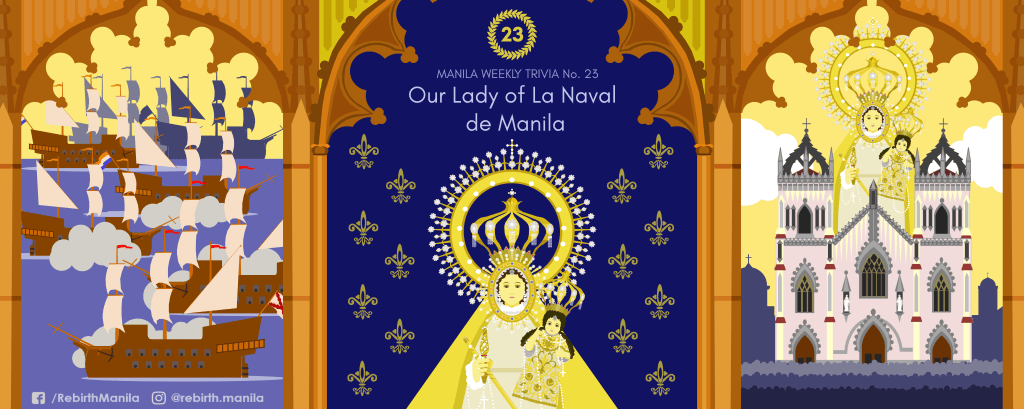
Our Lady of La Naval de Manila – depicts the overall image of the Blessed Virgin Mary in the Philippines, considering its celebration with grandeur processions, showered with shining jewelries as an honor from the devotees who continued to pray through her intercession .

October is the liturgical feast for all the images of Our Lady of the Rosary worldwide, and it is indeed that the celebration of the La Naval occurs during the ‘Month of the Rosary.’ In the year 1593, the new Spanish Governor-General Luis Pérez Dasmarinas commissioned a statue of ‘Nuestra Señora del Santísimo Rosario’ (Our Lady of the Holy Rosary) for public veneration in honor of his recently deceased father. Under the direction of Captain Hernando de los Rios Coronel, the image, with an approximate height of four feet and eight inches, the face and hands of Mary and the entire Child Jesus that is made of solid ivory, hardwood body in Bastidor style – commissioned to an anonymous Chinese immigrant who later converted to Christianity after the Virgin herself talked to him during the sculpting process. Later on, the statue was given to the Dominican friars and settled its new home at the Santo Domingo Church in Intramuros.

In 1646, naval forces of the Dutch Republic attempted to conquer the Philippines several times at Manila, in a bid to control trade in Asia. The war continuously repeated for eighty years, while the Spanish forces repelled their attacks various times. The Spanish forces, with the voluntary help of many native Kapampangans, with only three Manila Galleons, a galley, and four brigantines. They neutralize nineteen Dutch warships. Heavy damage was inflicted by the Spanish forces upon the Dutch squadrons, forcing them to abandon their attack in the Philippines. Under the intercession of the Spanish troops to the Virgin Mary, under the title of ‘Our Lady of La Naval de Manila’, all the victorious battles against the Dutch were considered and declared miracles by the Archdiocese of Manila after a canonical investigation. Nonetheless, more miracles happened long after the war, an example of that would be a mother who loss her 6-month old son. Walking down the aisle of the Santo Domingo Church in Intramuros, with thousands of parishioners inside the church, she kneeled before the image of La Naval saying “Mary, Mother of God. You have tasted the bitterness of the death of your Divine Son. Please, bring him back to me. I ask no more.” After saying this, her son was brought back to life.

The image merited several pontifical approbations from several papal:
Pope Pius X granted a Canonical Coronation in 1906, which was bestowed upon Dom Ambrose Agius of Malta in October 5, 1907 to perform the coronation for the La Naval de Manila.
Pope Pius XII sent an Apostolic letter on the occasion of the tricentenary of the Battle of La Naval de Manila on July 31, 1944.
Pope Paul VI proclaimed her patroness at Quezon City on October 13, 1973.
Pope John Paul II blessed the original image on February 19, 1981.

Today, the image is enshrined at the newly built Santo Domingo Church, located at Quezon City since 1954. Early this year, on January 2020, the image of La Naval de Manila once again visited Intramuros, where her old shrine once stood at the walled city.

Text and photography by Adam Daniel Reyes,
Banner art by Diego Gabriel Torres,
Multimedia Artwork by Angelo Andres,
Renacimiento Manila.
All Rights Reserved.
References (retrieved 10 October 2020)
www. mypope .com .ph/feast- of-la- naval-de- manila/
en. wikipedia. org/wiki/Our_Lady _of_La_Naval_de_ Manila
en.w ikipedia. org /wiki/Battles_ of_La_Naval_de_ Manila
trip advisor. com .ph/Attracti on_Review- g298574-d7785461-Reviews-Our_Lady_of_the_Most_Holy_ Rosary_of_ La_Naval_de_Manila-Quezon_City_Met ro_Manila_L.html


 Renacimiento Manila
Leave a comment