

Article and art by Diego Torres
14 December 2020
Intramuros today is a national treasure and a world-renowned tourist attraction (being voted recently as one of the best). People flock to the Walled City prior to the pandemic in order to relax, learn and bond with friends and relatives – and they are excited to do so again once restrictions and protocol allows for it. Intramuros is very much alive, having risen again from the carnage of war and the more destructive powers of urban decay.
But one thing that Intramuros has undeniably lost is its religious aura. The Grand Marian Procession is but a glimpse of the grandeur that was once “Holy” Intramuros. At the heart of this loss is the disappearance of the chapels, religious institutions, major churches and religious orders that once called Intramuros their home.
These churches or major places of worship have come to be called the Seven Churches of Intramuros. While the number seven is debated, the moniker is understandably made as an allusion to the Seven Wonders of the Ancient World. For this article, we are going to stick to the traditional list, that includes the Manila Cathedral, San Agustin, Santo Domingo, San Francisco, San Nicolas de Tolentino, San Ignacio and Lourdes.
Most of these churches are now gone, but allow us to once more introduce to you the Seven Churches of Intramuros.
The Manila Cathedral – the Mother Church

Gracefully rising in the civic center of Intramuros, is the dome of the Manila Cathedral. The Cathedral occupies a prime location, situated in front of the Plaza Mayor or Main square of Manila, flanked by the Palace of the Governor and the City Hall. For while the latter edifices are symbols and seats of secular power, the Manila Cathedral is the seat of the Archbishop of Manila. The cathedral is known as the mother of churches in the Philippines due to the crucial role of the Archdiocese of Manila in establishing churches and dioceses across the islands in the name of Christianity.
The cathedral we see today is a far cry from the first building to stand in this location. The original structure to rise here was the Church of Manila, which was built out of bamboo and nipa in 1571. When Manila became a diocese in 1979, a new cathedral was built in its place out of wood, bamboo and nipa. The first cathedral was finished in 1581. Since that time, the Cathedral has been rebuilt seven times as a result of natural calamities and decay.
The seventh cathedral was completed in 1879. This cathedral closely resembles the exterior that we see today in the Manila Cathedral. The new cathedral was built in a neo-Romanesque style, similar to Byzantine architecture. Perched on top of the cathedral was a massive dome that rose high above the roofs of the walled city.
It once had a bell tower, but an earthquake in 1880 led to the collapse of the belfry.
This Romanesque cathedral was destroyed by fire and artillery during the battle of Manila in 1945.
For almost a decade, the ruins of the cathedral stood boarded up amidst the desolate landscape of Intramuros. But in 1953 it was decided that the cathedral would rise again. In 1958, the new cathedral, the eighth structure, was completed. While it retained the exterior look and Byzantine theme of the prewar cathedral, the new cathedral was also a nod to a new beginning. It featured stained glass windows, mosaics and artworks by Filipino and Italian artists.
In 1981, the Cathedral was elevated by Pope John Paul II into a minor basilica.
Officially titled as the Minor Basilica of the Immaculate Conception, the Manila Cathedral today plays an important role in keeping the religious aspect of Intramuros well and alive in the 21st century. This includes hosting the annual Grand Marian Procession as part of the celebration of the Feast of the Immaculate Conception.
San Agustin Church – the Oldest and the Survivor
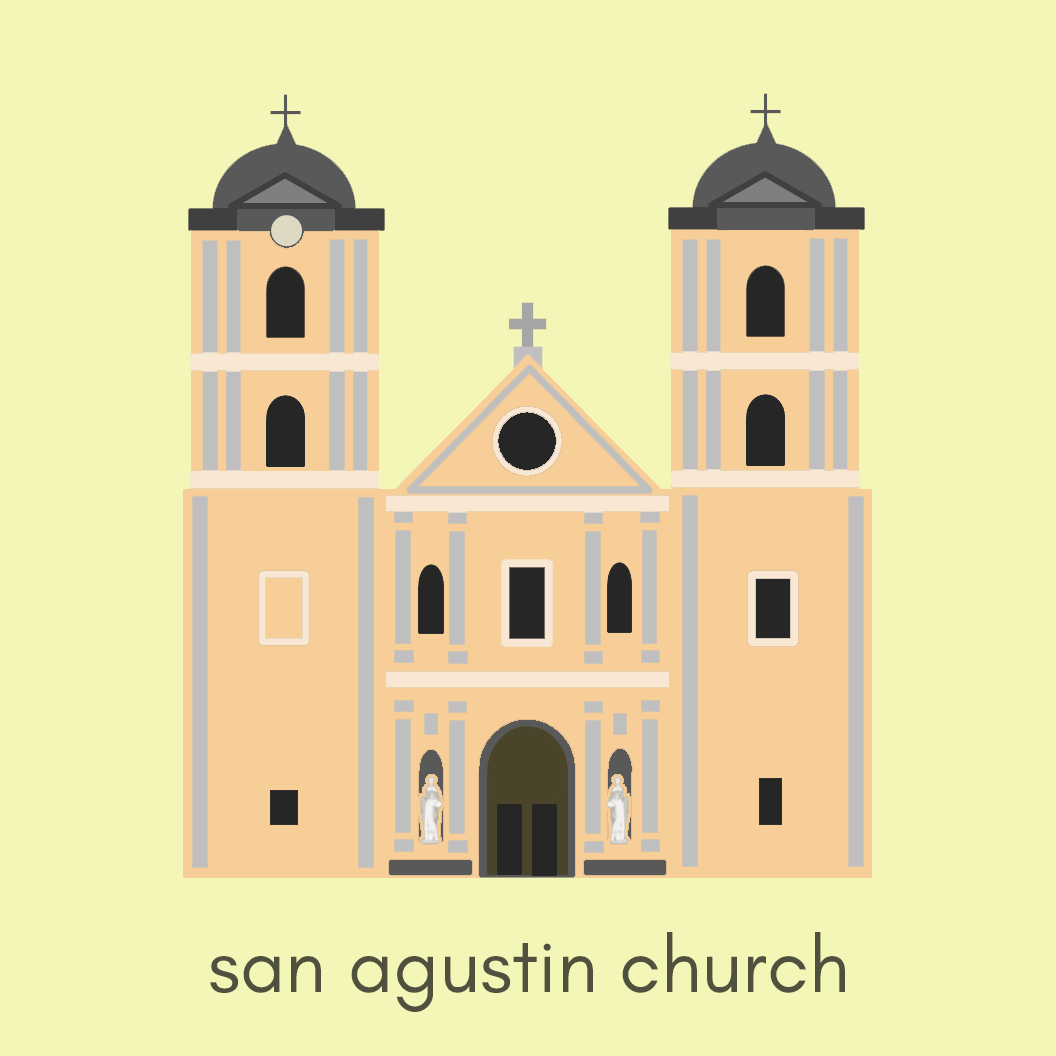
The next church is the one that through the centuries has seen the city rise and fall around it, all the while remaining standing – San Agustin Church.
The Augustinian Order, which was the first to arrive in the islands and in Manila, established their church and motherhouse in Intramuros in 1571. This simple structure of nipa and bamboo was destroyed by the pirate Limahong in 1574 during his attempt to take Manila, which failed. The church was once again destroyed by fire in 1583 and 1586. After these calamities, it was decided to rebuild the church out of stone.
With the help of Chinese craftsmen and Filipino laborers, the stone church rose up from the sand and dominated the city still made of bamboo, wood and nipa. San Agustin Church was completed in 1607, followed by its monastery in 1609.
Since that time, the structure has survived numerous natural calamities – most importantly earthquakes. It was looted of its ivory and silver treasures by British troops when Manila fell to British forces in 1762. The church used to have two bell towers, which were lower in height to what we see today. One of the towers was damaged by the 1880 earthquake and was removed.
During the Battle of Manila in 1945, San Agustin Church withstood mortar and artillery fire. It was spared from arson by the Japanese because the church was used as refugee camp for the civilians of Intramuros.
The battered structure was the lone survivor of the Battle of Manila in Intramuros.
The convent, which had been gutted by fire, was rebuilt in 1969. It now houses the San Agustin Museum.
The church itself is a famous venue for weddings. The baroque interiors, and the breathtaking 19th century trompe l’oeil ceiling and wall paintings, provide an elegant venue for exchanging vows.
Venerated in San Agustin Church is the image of Nuestra Señora de Consolacion y Correa.
Santo Domingo Church – the Fabled Shrine of La Naval

Just a few blocks east of the Cathedral, there once stood one of Manila’s most important religious shrines – the Santo Domingo Church.
The Dominican order was given a marshy patch of land near the river wherein they would build their church and motherhouse. This church was soon going to be an icon of the city.
In 1646, the Dutch invaded the Philippines with a superior number of forces. The beleaguered Spaniards and Filipinos beseeched the intercession of the Our Lady of the Most Holy Rosary to aid them achieve victory. After a series of naval battles, the Dutch were utterly defeated. These battles came to be known as the Battles of La Naval. The victorious forces walked barefoot to Santo Domingo, where an image of the Our Lady of the Most Holy Rosary was housed.
An annual celebration was eventually declared, known as the Feast of La Naval. The feast culminates in a procession of the image of the Our Lady of the Most Holy Rosary which came to be known as Our Lady of La Naval. This procession was one of the grandest and most anticipated religious events in the city.
The church that housed the image fell several times until it was rebuilt in 1868. This new church was built in the Neo-Gothic style, with spires, crowns and finials and other gothic features that were integrated in a squat traditional church structure as a means to protect it from earthquakes.
The church was among the largest in Intramuros and was beloved by Manileños as a landmark of the city.
Its end came not by earthquake but through the pounding of Japanese bombs and their ensuing blaze. Santo Domingo was bombed by Japanese planes in 1941, reducing it to ruins. The ruins were further damaged during the battle of Manila.
After the war, the Dominicans moved out and rebuilt Santo Domingo in Quezon City. The ruins in Intramuros were pulled down and the land sold to several corporations. The lot is occupied today by the BIR and a bank. Where the altar once stood, there now one finds tellers.
San Francisco Church – The Franciscan Twins
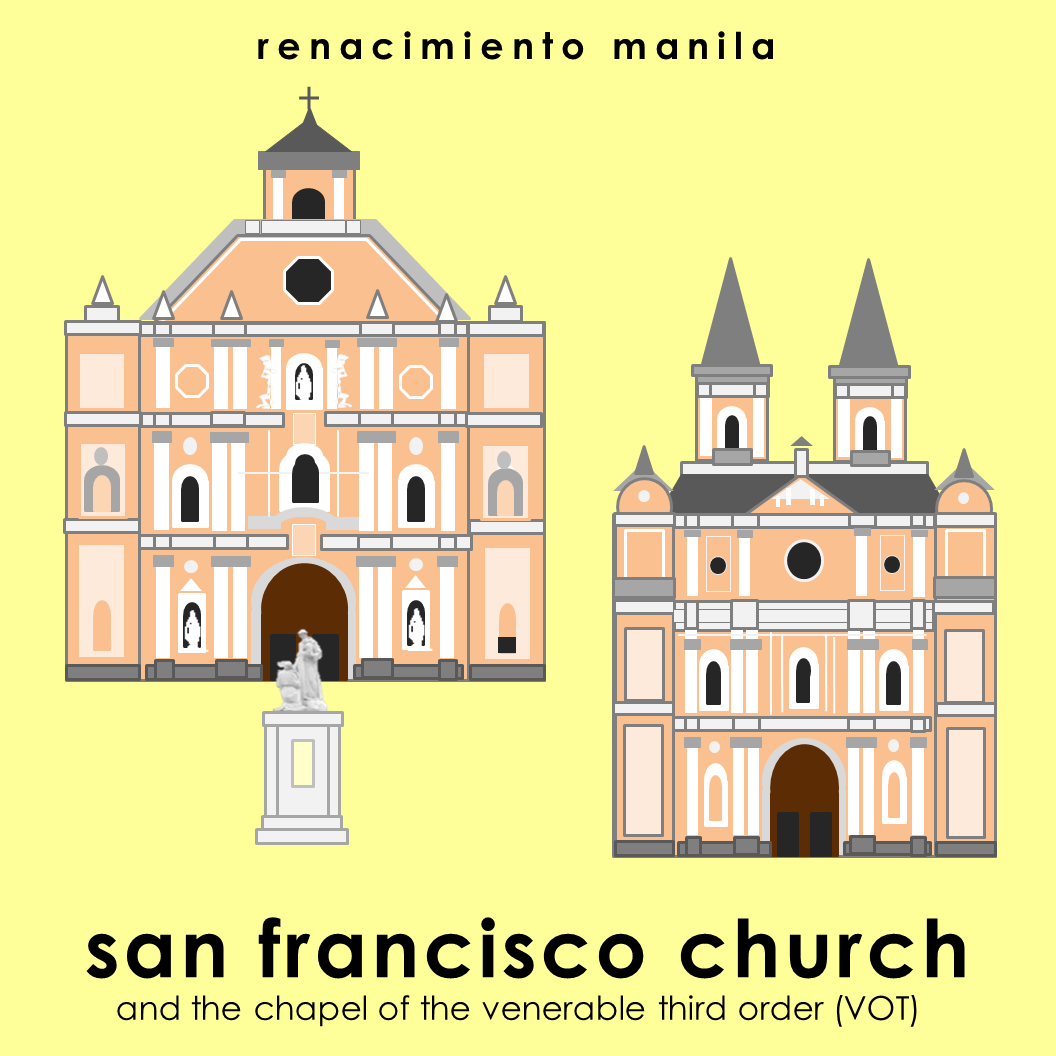
Near the eastern walls of Intramuros, there once stood the compound of the Franciscan order
The first church was built here in 1578, made of bamboo and nipa. The church burned down in 1583, along with the rest of the city. A new stone church was built in 1602. Right next to it was a new hospital. This hospital, started by the Franciscans, would eventually become the San Juan de Dios Hospital, the largest private hospital in Manila prior to World War II.
Earthquakes damaged the church and so in 1739, work began on a new church. This Baroque church, completed in the 18th century, would become a memorable landmark.
The new church was spacious and had elegant interiors.
Next to it stood a chapel for the Franciscan tertiaries, known as the Chapel of the Venerable Orden Tercera. In the 18th century, the church and the chapel were built to resemble each other, like twins. The chapel had to undergo renovations in the 19th century, which saw the addition of two belfries on top, thus altering its appearance.
The church was a church for the masses, and was also frequented by tourists in the early 20th century.
Housed inside the Franciscan church was an image of the Immaculate Concepcion which was brought out for the celebrations in December.
The image, church, chapel, convent and the adjacent hospital were all destroyed during the Battle of Manila in 1945.
The Franciscans moved out to Makati after the war and the land was sold. The site is now occupied by Mapua University.
In the courtyard that used to be filled with vendors and the faithful, only a quiet street corner and a generic building could be seen.
San Nicolas Tolentino Church – The Recollect Motherhouse

Our next church stood in the south end of Intramuros. Its tall bell tower stood high in the vicinity, a landmark in the south of Intramuros. This was the San Nicolas Tolentino Church of the Augustinian Recollects.
The first Recollect church was located in Bagumbayan, just outside the walls of Manila. In 1608, they were able to build a church inside Intramuros, on a lot that was donated by the governor general. In the centuries that followed, natural calamities would frequently destroy the church. In 1881, a new church was built. This church would be renowned for its elaborate interiors and grand architecture.
The interiors of San Nicolas Tolentino were partially modernized in the 1930’s.
Among the famous images found inside the church was the original Black Nazarene image from which the image in Quiapo was copied in the 18th century. This particular image was only brought out during the Easter celebrations.
The church and its convent was destroyed during World War II. The Recollects moved their motherhouse to another Recollect property, the San Sebastian Church in Quiapo. The ruins of Recoletos remained standing, even used for shooting films, until it was demolished in 1959.
The site is now occupied by the offices of the Manila Bulletin.
San Ignacio Church – The Golden Dream
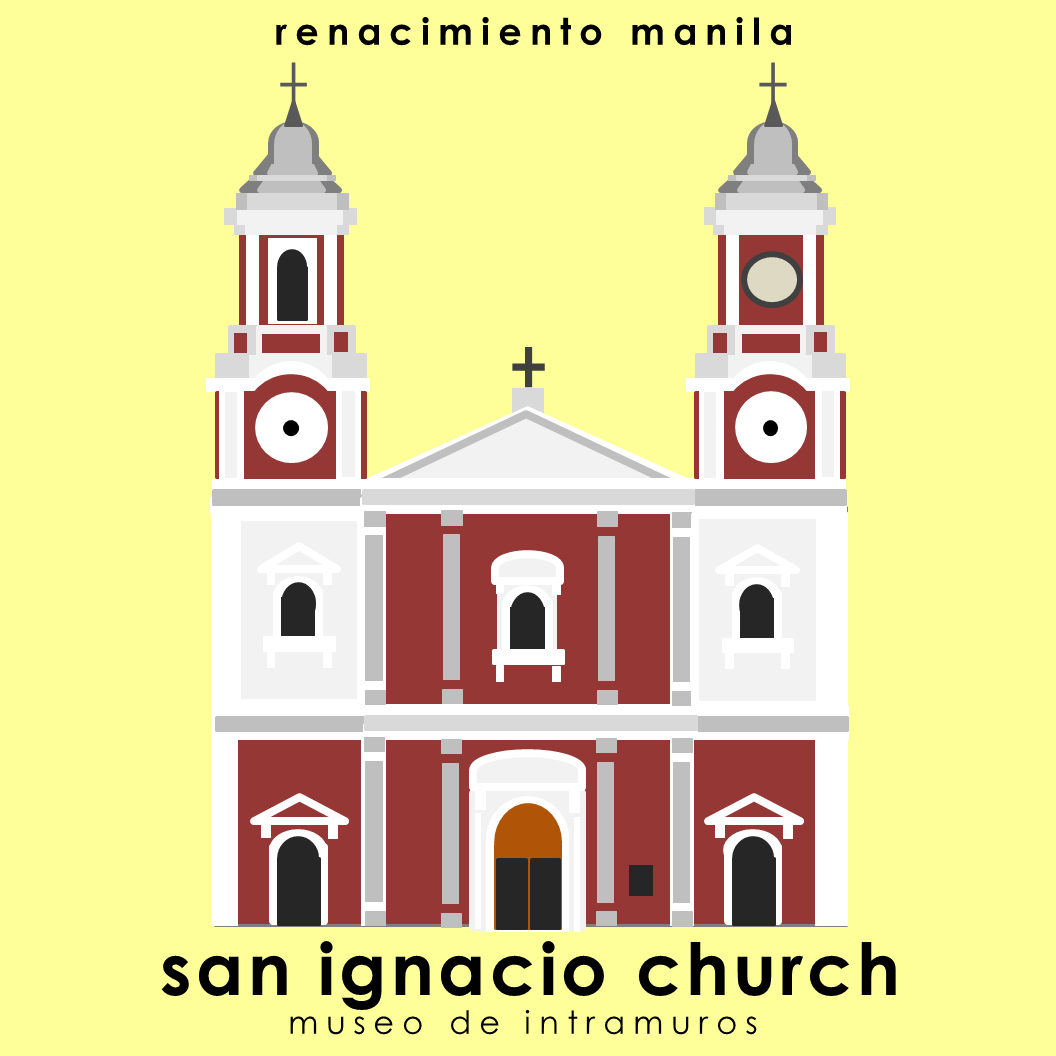
The first Jesuit compound was located in a vast property in the southwest corner of Intramuros. The Jesuit compound included their church, motherhouse and two colleges. But the Jesuits were evicted from the Philippines in 1768. The property was seized by the government. Within a hundred years, the religious compound was turned into barracks and church – damaged by earthquakes and rot – was eventually demolished.
In 1859, the Jesuits returned. They were eventually given a small parcel of land next to the Archbishop’s Palace along the seaside walls. It was here that they built their new church in 1878.
The new Jesuit church, called San Ignacio Church, was a neoclassical masterpiece. The exteriors featured twin bell towers, while a small courtyard in front of the church was fenced by wrought iron grills. While the exterior seemed simple, the interiors were ten times grander. The interior was decorated with wooden sculptures, panels and reliefs, executed by Filipino craftsmen led by Isabelo Tampinco, Jr. The ceiling and pulpit alone were a marvel to behold.
Sadly, the church was torched by Japanese forces in 1945.
The shell of the building was used as a warehouse and later abandoned.
In 2019, reconstruction work on the adjacent Jesuit Mission house was completed, while reconstruction of the San Ignacio itself is half completed. The complex is now part of the Museo de Intramuros.
Lourdes Church – The Capuchin Shrine

The last church of the seven is the “youngest”. The Capuchins settled in a lot along Calle Real del Palacio (modern Gral. Luna Street) in 1891, establishing a convent and a chapel dedicated to the Divina Pastora. But in 1892, the veneration of Our Lady of Lourdes began. An image of Our Lady of Lourdes, carved by a Filipino, was placed in the altar by the request of several devotees. A new church was underway when the Spanish American War broke out. As threats of a naval bombardment from Dewey’s fleet loomed, the Capuchins beseeched the protection of Our Lady with the promise of dedicating the new church to Our Lady of Lourdes.
After the war, work on the church continued and as promised, the new Capuchin church was dedicated to Our Lady of Lourdes.
The church stood along General Luna for 40 years, hosting weddings and other religious events. In 1945, during the battle of Manila, the Capuchins were massacred by the Japanese and the church destroyed. The image of Our Lady of Lourdes survived because prior to being massacred, the Capuchins were able to bring the image to the safety of San Agustin Church.
The Capuchins built a new church in Quezon City. The ruins in Intramuros were demolished.
The site is now occupied by an arts and crafts store and a restaurant.
Article and art by Diego Torres
Renacimiento Manila. All Rights Reserved.
References
Torres, J. V. (2005). Ciudad Murada A Walk Through Historic Intramuros. Manila: Vibal Publishing House, Inc. , Intramuros Administration.
Manila Cathedral Official Website

The Renacimiento Movement. What, then, is the Renacimiento Movement? The movement is the core philosophy of the organization. It is founded on the reality that heritage is a cornerstone of holistic development and that it is indispensable in ensuring quality of life. As such, cultural revival is necessary for the promotion of heritage in the national agenda. Heritage should be driven by the people, regardless of race, gender, creed, or religion. This cultural revival can be achieved through the following ways: government support, the advancement of private initiatives, and the engagement of the people.

 Renacimiento Manila
Leave a comment