
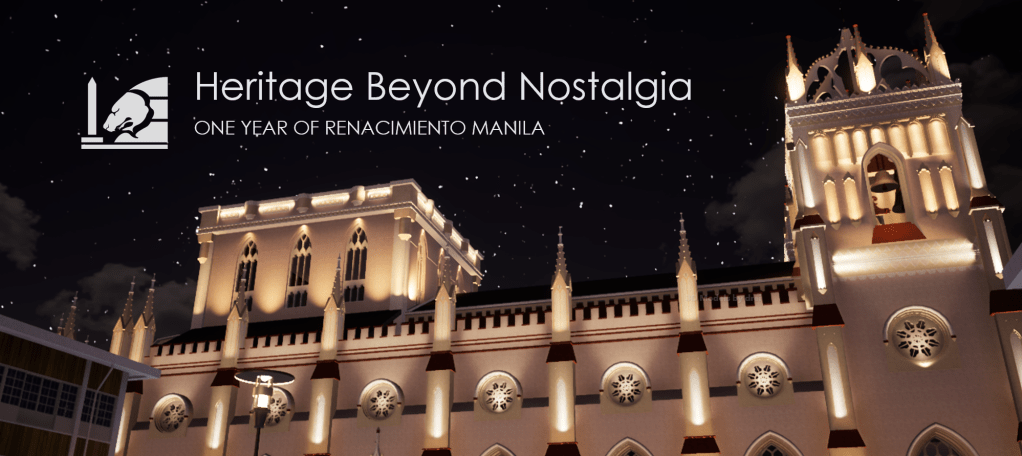
January 16 marks Renacimiento Manila’s first anniversary. From a simple spark resulting from a meeting of minds by its founders, Renacimiento Manila has grown into a young organization with a distinct character and youthful manner by which it advances its advocacy for heritage and urban renewal in Manila.
Renew, Rebuild, and Rejuvenate
Our guide, as always, is composed of these three words as we move forward.
Renacimiento Manila is driven by its vision for the future of Manila. It is a vision of a progressive and livable city, a city of the future with its feet firmly set on honoring its unique history and heritage. A city where the past and the present do not collide but are integrated instead to create cultural flowering, economic opportunities and urban renewal of the decaying “Pearl of the Orient”.
We believe passionately that progress must not mean the demolition of the past; that development does not only mean obliterating centuries old city defining landmarks to be replaced by high-rise buildings. The past – history and heritage – is not a dead thing; when properly utilized and harnessed, it has the capacity to generate economic growth especially in Manila.
Hence, as an advocacy group, we go beyond nostalgia for we build upon it in order to make the past an inspiration for the future. Renacimiento Manila does this by using the modern tools available in order to reach a wider audience, whatever age they may be and wherever they may be.
Through traditional art we create artworks of our vision of the city, as well as vision of the past. Through the creative genius of our members, we create 3D models of our vision, as well as models of Manila’s past, in order to make history vivid and colorful.
We also create vectors and other digital art that gives new life to the city’s otherwise unappreciated collection of architectural treasures.
Our advocacy also pushes for educating the people regarding the importance of Manila’s landmarks and other relevant aspects of the city. Hence, we have our weekly articles at Manila Weekly.
Renacimiento Manila also does not work alone. We work and connect with other organizations in safeguarding the city’s heritage buildings. To this end, we have joined the Save San Sebastian Basilica campaign. And no matter how young we are as an organization, we are more than ready to join others in their fight for heritage and urban renewal – such as the protection of Santa Ana, and resistance to the Pasig River Expressway which is an urban blight and a disaster waiting to happen.
This coming year will be an important year, for much remains to be done.
We plan to expand our digital 3D models of Manila – past and future. We are also working on creating a large model of prewar Intramuros which we shall gift to the people of Manila.
Our vision and plans go beyond social media. It includes the creation of institutions, new museums, learning centers, alternative transportation services, promotion of pedestrianization, cultural exhibits, school hops, reconstruction of key landmarks, protection of important heritage zones, passage of ordinance and legislation on a local and national level, art fairs, history fairs, parades, assistance in the improvement of Manila’s tourism, cultural programs for the poor, community cultural seminars, and economic opportunities to the locals of Manila’s communities.
Imagine crossing the revitalized Lagusnilad and then going to Intramuros; its streets friendly to pedestrians and exuding the historical ambiance that everyone feels in Vigan or Taal. From Victoria, you head to the Colonial Arms museum in order to learn about warfare during the past 400 years – or maybe to the Costume Museum to learn about costumes and clothing from the past. From there, you walk to Plaza Santo Tomas, passing by book stores, cafes, small restaurants and inns. In the plaza, you gaze in awe at the reconstructed Santo Domingo, and then explore the rebuilt old UST building to explore its learning center, or attend a lecture. From there you head to the Plaza Mayor, where several tour bus “tranvias” mingle with real commuter trams. From here you can board a tour tram to go to other heritage districts – Quiapo, San Nicolas, Santa Ana, Escolta-Binondo and San Miguel. You can go to Quiapo and visit its Heritage District, stopping by the grand houses and adaptive reuse buildings in a vibrant community, as you head for San Sebastian Basilica – a building standing proud without a photo bomber condo.
From Quiapo you return to Intramuros for the evening to catch a cultural event in its plazas and gardens. But there will also be events in Escolta, Quiapo and Santa Ana, so you have to decide which tram to board.
This is just a glimpse into our vision.
We thank everyone who supports us and everyone who has supported us in the past year. We are ever grateful. Together, we will create the Manila that we deserve and return Manila – vibrant and unique – into its rightful place as the Pearl of the Orient and the Queen of the Pacific.
Mabuhay ang Maynila! Viva Manila!
Renacimiento Manila. 17 January 2021. All rights reserved.

The Renacimiento Movement. What, then, is the Renacimiento Movement? The movement is the core philosophy of the organization. It is founded on the reality that heritage is a cornerstone of holistic development and that it is indispensable in ensuring quality of life. As such, cultural revival is necessary for the promotion of heritage in the national agenda. Heritage should be driven by the people, regardless of race, gender, creed, or religion. This cultural revival can be achieved through the following ways: government support, the advancement of private initiatives, and the engagement of the people.

 Renacimiento Manila
Leave a comment