

By Carlos Cucueco III and Diego Torres
26 March 2021
Last week, we tackled several of Manila’s renowned educational institutions for women. By popular demand, we are back with part 2, focusing on other important schools in the City of Manila which were either mentioned in passing earlier, or were not mentioned at all.
Concordia College
Located in the district of Paco, the Escuela Pia was founded in 1868 by Doña Margarita Roxas de Ayala and under the administration of the Daughters of Charity. The institution was also known as the Colegio de la Inmaculada Concepcion de la Concordia which we know today as Concordia College. This school was known because some of Rizal’s sisters (Saturnina, Olimpia and Soledad) and his lovers (Segunda Katigbak and Leonor Rivera) studied here and it was also mentioned in his novel Noli Me Tangere.
During the battle of Manila in 1945, the school was swarmed by refugees who were fleeing from the devastation and bloodbath. Unfortunately, due to wrong intelligence reports, the Americans shelled Concordia College furiously, leading to the deaths of many refugees and inflicting damage on the campus.
Although the school remains standing in its original site, the structures inside are already modern. There are very few records on what happened to the buildings that once stood on the site through the years as a result of the school’s long years of existence.
Assumption College (formerly in Manila, currently in Makati City)
A few years before the end of the Spanish Era in the Philippines, the Queen Regent of Spain, Maria Christina, requested sisters of the Congregation of the Religious of the Assumption to come to the Philippines to establish the school for women teachers. In 1892, the Superior Normal School was established inside the walls of Intramuros. Among the notable products of the Superior Normal School were founders of other educational institutions for women such as Rosa Sevilla de Alvero (Instituto de Mujeres), Librada Avelino and Carmen de Luna (Centro Escolar University). The Philippine Revolution of 1898 suddenly halted the operations of the Congregation of the Religious of the Assumption.
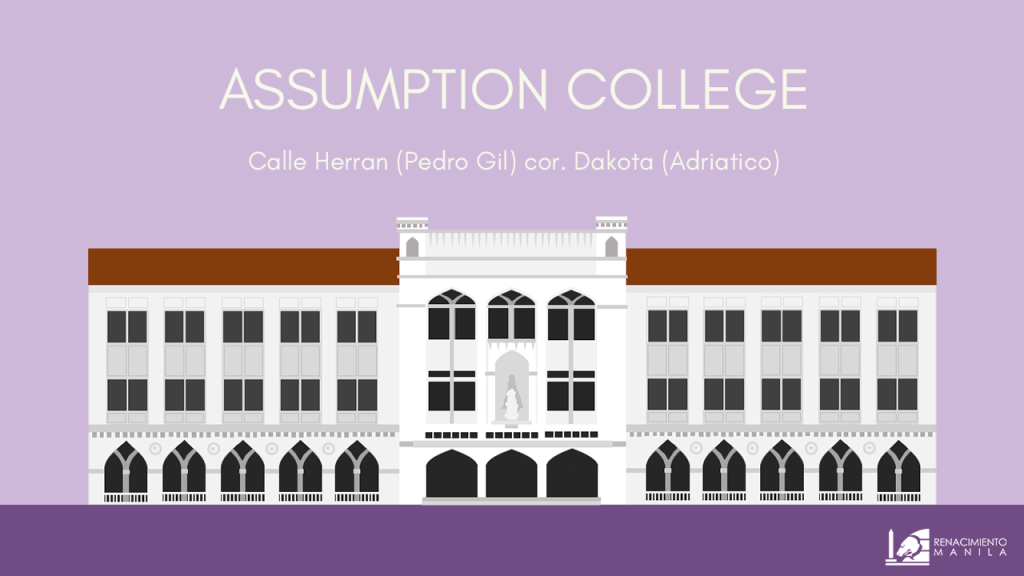
In 1904, the Congregation returned to Manila at the request of Pope Pius X. They opened a boarding school for elementary and high school students on Herran Street in Malate. In 1940, they added a college department to cater to the advancement of education during that time.
During the Liberation of Manila in 1945, most of the school along with the convent of the Congregation was destroyed by fire. Immediately after the war, the school reopened its doors to students, and they held classes in military quonset huts as temporary facilities. Reconstruction of the buildings began after a few years.
The emergence of Malate as a commercial center coupled with the creation of new campuses such as those in San Lorenzo, Makati (where they are currently located) resulted in the closure of the Herran campus.
Robinsons Place Manila currently stands on what was once the site of Assumption College.
St. Scholastica’s College

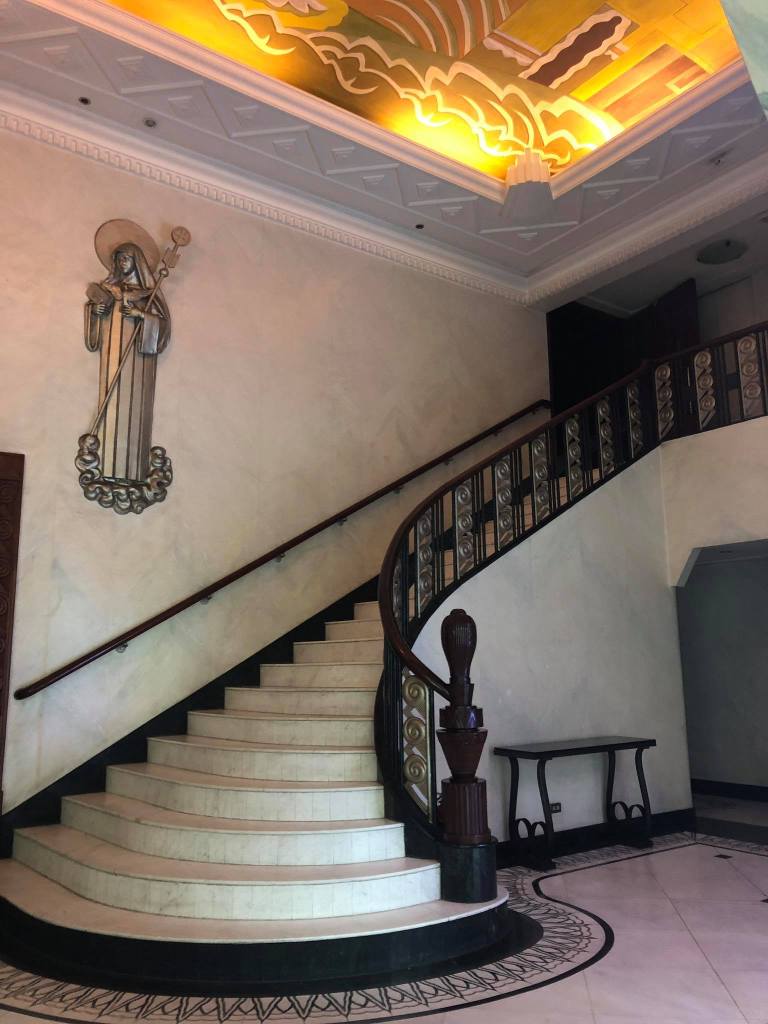

St. Cecilia hall interior 
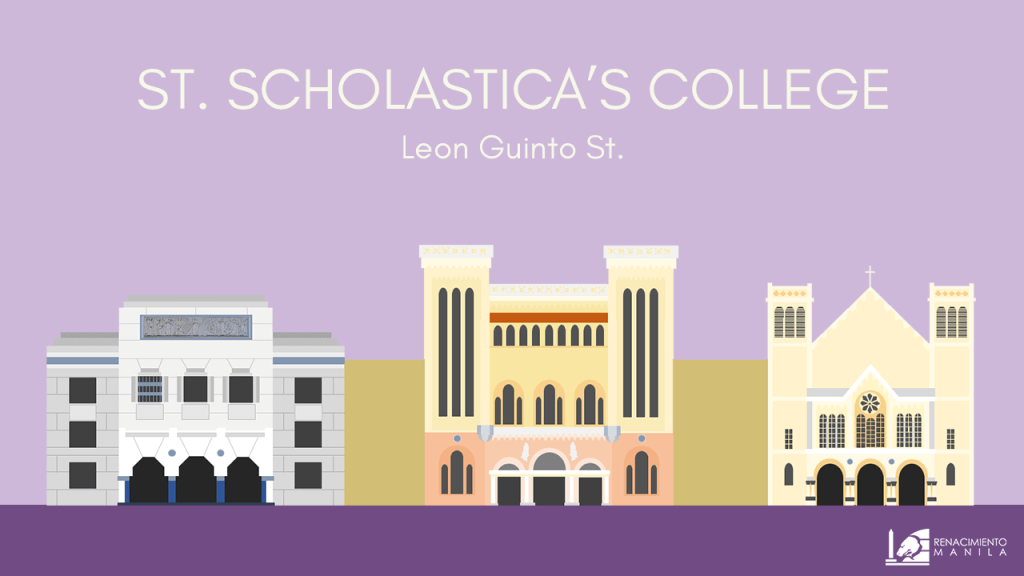
In 1906, sisters from the Missionary Benedictine Sisters of Tutzing arrived from Germany to form what we know today as St. Scholastica’s College. They started the school on Moriones Street in Tondo as a wagon-shed without windows. In the following year, they transferred to a lot in San Marcelino Street that was donated by the Archbishop of Manila, Most Rev. Jeremias Harty. In 1909, the school was elevated as a college and at the same time, their Conservatory of Music was created. During the Silver Jubilee of the Conservatory of Music, St. Cecilia’s Hall was built. The design of the hall was created by Ar. Andres Luna de San Pedro, the son of the famous Juan Luna. Named after the patron saint of music, St. Cecilia’s Hall became a venue for many concerts and recitals during Manila’s pre-war years, thus establishing the prestige of the school.
After a few years, a bigger lot was allotted to the school through the initiative of Archbishop Harty. This would be the present location of the institution. During the Japanese Occupation, the school complex was sealed as a property of the Japanese Imperial Army. The complex was transformed as a hospital. Towards the end of the war, a bomb set the school complex on fire which unfortunately affected St. Cecilia’s Hall.
After the war, the school slowly rebuilt their destroyed complex and after two years, they re-opened their gates to students. In 1955, the reconstructed St. Cecilia’s Hall was opened to the public. The reconstruction was made possible with the collaboration of Ar. Roberto Novenario and Engr. Ramon del Rosario. In 2006, the institution celebrated their centennial anniversary and in the following year, the National Historical Institute unveiled its historical marker.
St.Theresa’s College (formerly in Manila, currently in Quezon City)
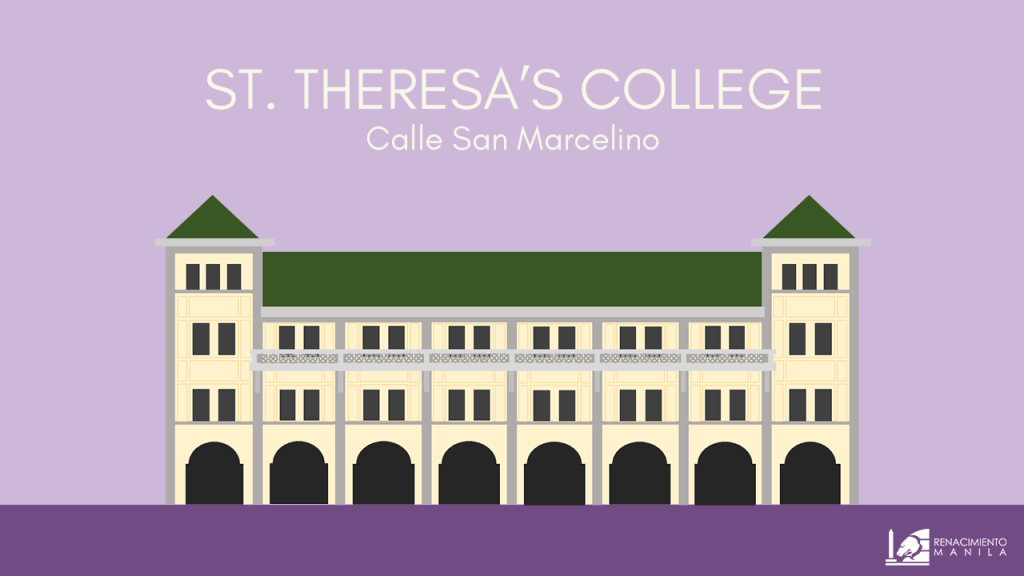
In 1915, the Missionary Sisters of the Immaculate Heart of Mary (ICM) headed by their foundress Mother Marie Louise de Meester established St. Theresa’s College Manila, which is situated in San Marcelino, Manila. They were invited by Archbishop Harty beforehand for them to establish their congregation in Manila after they arrived in Tagudin, Ilocos Sur in 1910.
During the Second World War, their school became one of the unfortunate casualties of war. Fortunately, a bigger lot was donated by the Tuason Family which is in Sta. Mesa Heights, Quezon City. The school transferred in 1947 and is still there until today.
——
These are perhaps just some of the most important educational institutions for women. Most schools today are co-ed, where both men and women have an equal footing in terms of learning. The schools which we discussed are a testament to the long road that our people, especially Filipinas, travelled in the past, in their yearning to educate their fellow women in order for them to have access to opportunities which education will allow.
Article by Arch. Carlos Cucueco III and Diego Torres.
Renacimiento Manila. All rights reserved.
References
Saint Scholastica’s College website – History; Cecilia’s Hall
Assumption College website
Philstar
St. Theresa’s College website
La Concordia College Website ; Archive ; History

The Renacimiento Movement. What, then, is the Renacimiento Movement? The movement is the core philosophy of the organization. It is founded on the reality that heritage is a cornerstone of holistic development and that it is indispensable in ensuring quality of life. As such, cultural revival is necessary for the promotion of heritage in the national agenda. Heritage should be driven by the people, regardless of race, gender, creed, or religion. This cultural revival can be achieved through the following ways: government support, the advancement of private initiatives, and the engagement of the people.
 Renacimiento Manila
Leave a comment