
Text by Meijie Ureta
For the past 118 years, the University of the Philippines (UP) grew into the system of honor, excellence, and service it is lauded for today. Known as the country’s top university, it produced national leaders, spearheaded scientific breakthroughs, breathed life to artistic revelations, and mobilized Filipinos for social change.
The common denominator of these outcomes is that UP became a university for the Philippines by building local knowledge and fostering a love of country, especially for a Philippines whose national identity can still be difficult to pinpoint and whose history remains entangled with incomplete narratives.
On that note, UP’s origin saw the absence of a known Philippine selfhood; the UP system can be traced back to Manila, specifically Ermita, when it was a simple determination for a Filipino education amid the legacy of colonial power.
The legislation that formed UP
The year was 1908, a decade since Philippine independence from Spain. Now under the control of the United States (US), the First Philippine Assembly sought to establish a local higher education institution. This led to the craft, by Secretary for Public Instruction (then the name of the Department of Education) William Shuster, and signing of Acts No. 1870 also known as the “University Act.”

Manila became the location, which was suggested in Section 1, for the inaugural UP school. The government was able to acquire a 10-hectare square lot in Ermita, which the perimeter is surrounded by United Nations Avenue (formerly Calle Isaac Peral), Padre Faura Street, Maria Orosa Street (formerly Calle San Antonio), and Taft Avenue (though already a main road, was unnamed).

The legislative vision for UP was that it sought to “provide advanced instruction in literature, philosophy, the sciences, and arts, and to give professional and technical training” according to Section 2; and that applicants shall not be denied admission “by reason of age, sex, nationality, religious belief, or political affiliation,” in accordance to Section 3.
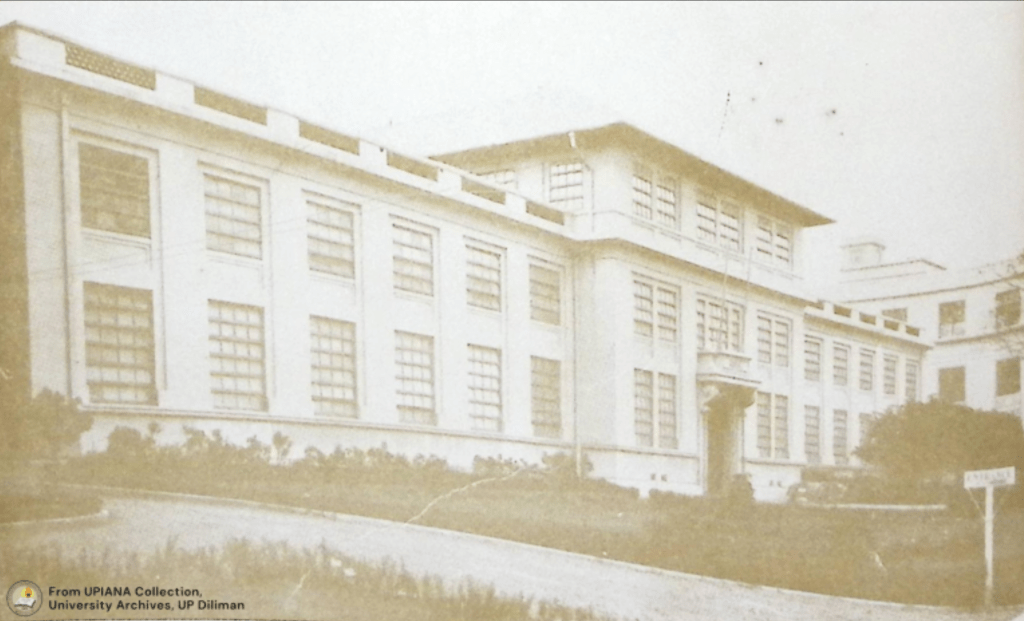
UP officially opened its doors in Ermita, Manila in 1909 with its first colleges being medicine, fine arts, and liberal arts. Additional colleges such as law, engineering, music, veterinary medicine, and education, would follow suit in succeeding years.
Education by and for the Filipino
With UP’s establishment under US colonial rule, the dogmatic and caste-selective education of the Spanish colonial era was dismantled. For one, UP is the first school in the country to open education to women, which later on introduced the co-education admission practice. Meanwhile, the country was given more access to global trade amid rising modernization in the early 20th century, and this provided UP access to the most modern medical equipment of the time.
These circumstances paved the way for UP to be the top university of the country. But more than new materials and higher admissions, UP introduced the concept of academic freedom in the country, where Filipinos have agency over their intellect and expression, empowering local knowledge in the fostering of a Filipino identity and nation. UP Manila (UPM), as the birthplace and witness of UP’s formative years, was central to developing these principles.

The schools of the UP System grew with their own specializations. UPM became notable for its leading education in medicine, where scientific approaches were introduced and emphasized in addressing health issues. When tropical disease outbreaks such as malaria, cholera, and smallpox were spreading in the country, UPM spearheaded the introduction of hygiene and sanitation practices as well as the production of treatments using local ecosystems.
The origins of UPM can be traced back to the Philippine Medical School (PMS), established in 1905 to promote medical education and address the need for additional doctors in the country. PMS was renamed and has been known as UPM’s College of Medicine since 1923.

Additionally, UPM is alongside the Philippine General Hospital (PGH). Established in 1907 and opened shortly after UPM in 1910, PGH ought to provide public patient care as well as clinical training. In the next two decades, UPM would open colleges of various medical fields such as pharmacy, dentistry, and hygiene.

In 1935, the Oblation, the statue that became the symbol of UP, was inaugurated in UPM. Crafted by Guillermo Tolentino, a Fine Arts alumni and National Artist for Visual Arts in Sculpture, the Oblation was inspired by Dr. Jose Rizal’s poem “Mi Ultimo Adios,” particularly the second stanza that describes the offering of one’s life in serving the nation.
Manila’s devastation, UP’s center moved to Diliman
UP was immediately closed when World War II began in December 1941. And when the Japanese occupied Manila in 1942, they transformed the UPM campus into one of their headquarters. PGH remained unoccupied, except for its administrative offices, to remain in service to the public.
Critical UPM colleges such as the College of Medicine continued their operations; the said college hosted classes in its building as well as in PGH. However, there was constant surveillance and repression by the occupying Japanese forces, making it difficult to conduct education with freedom and ease.


Later on, particularly when the Americans were approaching Manila for its liberation, UPM’s operations were debilitated due to growing fear of escalating battle. Meanwhile, PGH continued to serve the sick, wounded, and displaced throughout the wartime, may they be Filipino, Japanese, or American.
After the Battle of Manila in February 1945, the entire UPM campus suffered total damages, from shellings to strafes. All buildings were inhabitable and many of its records as well as medical equipment were destroyed.
The rehabilitation of the UPM campus began with a secured grant from the US-Philippines War Damage Commission the same year. Meanwhile, the grant also covered the resumption of the campus developments at Diliman, Quezon City, to which its established buildings sustained lesser damages compared to Manila.


By 1949, while the Ermita campus was gradually rebuilding and expanding in terms of architecture and enrollment, Diliman saw major developments that prompted multiple administrative and academic units to transfer there. With the symbolic transfer of the Oblation statue that same year, Diliman became the main campus of the UP System.
UP Manila as the center of Philippine healthcare
UPM’s expertise and mission in clinical education and healthcare in the Philippines fortified as the Colleges of Medicine, Dentistry, and Public Health stayed in Ermita. The Manila campus expanded further into the fields of public health, nursing, and allied health professions after the war, following suit were the College of Arts and Sciences, National Teacher Training Center for Health Professions, and the School of Health Sciences or campuses Leyte, Koronadal, Tarlac, and Aurora that promote health education in remote communities.


REFERENCES
- Act No. 1415, December 01, 1905. (2019). Supreme Court E-Library. https://elibrary.judiciary.gov.ph/thebookshelf/showdocs/28/15933
- Acts No. 1870, June 18, 1908. (Retrieved June 2026). The LAWPHIL Project – Arellano Law Foundation. https://lawphil.net/statutes/acts/act1908/act_1870_1908.html
- Dacumos, R. (2013). Philippine Colonial Education System. ResearchGate. https://doi.org/10.13140/RG.2.1.2507.7600
- Guillermo E. Tolentino (1890-1976). (Retrieved June 2026). National Historical Commission of the Philippines National Registry of Historic Sites and Structures. https://philhistoricsites.nhcp.gov.ph/registry_database/guillermo-e-tolentino-1890-1976/
- Historical Perspective of the Philippine Education System. (Retrieved June 2026). Department of Education. https://www.deped.gov.ph/about-deped/history/
- Honor, excellence and service to the nation: UP in the past 118 years. (2026). University of the Philippines. https://up.edu.ph/university-history/
- Liberation of Manila. (2025). The University Library, University of the Philippines Diliman. https://mainlib.upd.edu.ph/liberation-of-manila/
- Lippman, D. (2024). Destroying the Pearl: Liberation of Manila. Warfare History Network. https://warfarehistorynetwork.com/article/the-battle-of-manilla-destroying-the-pearl/
- Our History. (2022). University of the Philippines Manila – the Health Sciences Center. https://www.upm.edu.ph/about-history-overview/
- Philippine General Hospital. (Retrieved June 2026). National Historical Commission of the Philippines National Registry of Historic Sites and Structures. https://philhistoricsites.nhcp.gov.ph/registry_database/philippine-general-hospital/
- UPM history unfolds through pocket museums, other projects. (2024). University of the Philippines Manila. https://www.upm.edu.ph/cpt_news/upm-history-unfolds-through-pocket-museums-other-projects/
- UP Naming Mahal: The Genesis of 9 UP Campuses. (2025). The University Library, University of the Philippines Diliman. https://mainlib.upd.edu.ph/up-naming-mahal-the-genesis-of-9-up-campuses/#upm
Text & Image Collection by Meijie Ureta
All Rights Reserved. 2026.

RENACIMIENTO MANILA is a group of artists, creators and history enthusiasts committed to promote and realize Manila’s cultural rebirth.
It is founded on the reality that heritage is a cornerstone of holistic development and that it is indispensable in ensuring quality of life. As such, cultural revival is necessary for the promotion of heritage in the national agenda. This cultural revival can be achieved through the following ways: government support, the advancement of private initiatives, and the engagement of the people.
 Renacimiento Manila
Leave a comment