
Aly Garcia
07 Feb 2021
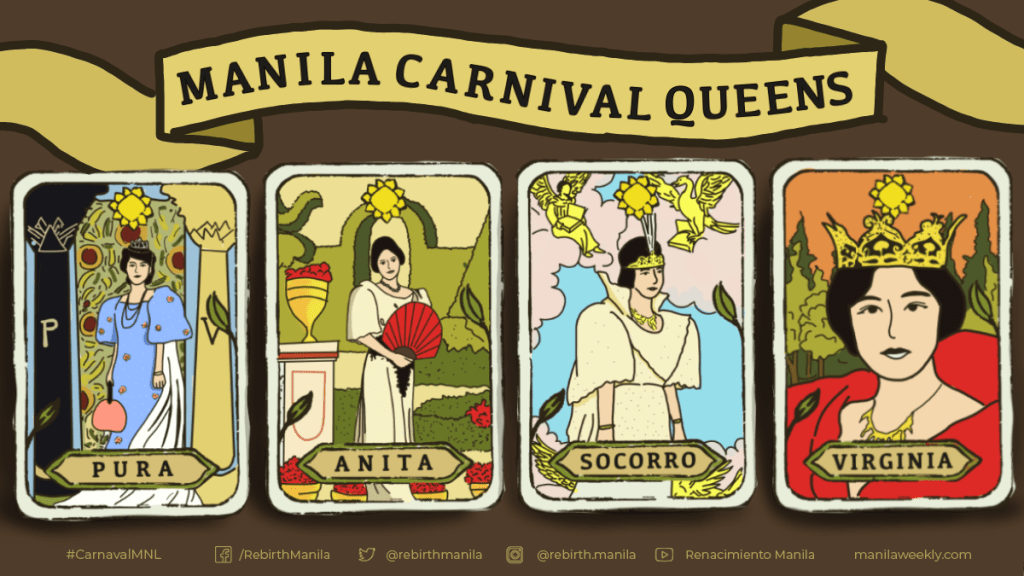
Manila Carnival was first established by the American colonial administration in February 1908 to celebrate the harmonious relationship between them and the Filipinos. It also highlights the industrial, commercial, and agricultural development of the Philippines during their administration. However, the main highlight of the event was the crowning of the Carnival Queen which became the precursor to various beauty pageants in our country. The following women were among the first beauty queens of the Philippines.
Pura Villanueva – First Manila Carnival Queen, 1908
Purificacion Villanueva y Garcia was only 22 years old when she became the first ‘Queen of the Orient’ in the first Manila Carnival in 1908. This makes her the first Filipina beauty queen in our country. She was born on August 27, 1886 in Arevalo, Iloilo City to Emilio Villanueva who was an ilustrado and Emilia Garcia who was born in Palencia, Spain.
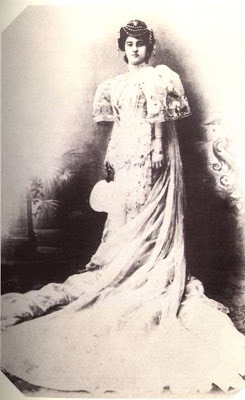
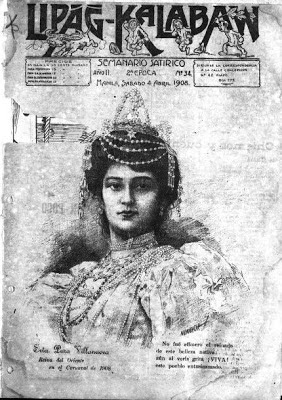
Pura was an advocate even before her coronation. In 1906, she founded the Asociacion Feminista Ilongga where her efforts in leading resulted in the first suffrage bill to reach the Philippine Assembly in 1907. This was also the first known suffragette movement in the Philippines headed by women. She also became a president of the Women’s Club of Manila.
Other than being a feminist leader, Pura was also a writer. She wrote a column for a weekly newspaper named El Tiempo and was editor for the women’s section of the newspaper. She then published multiple books such as the Osmeña from Newspaperman to President (1946), How the Filipina Got the Vote, Outstanding Filipino Women, Anthology of Filipino Women Writers, The Consumer Cooperatives in the Philippines, The Filipino Cookbook, and A Brief History of the Filipino Flag. Then she also published one of the earliest cookbooks in the Philippines, the Condimentos Indigenas in 1918
Pura Villanueva married Teodoro Kalaw in 1910 and gave birth to Maria Villanueva Kalaw which also became a Carnival Queen in 1931, the first second-generation queen (mother – daughter carnival queens) in Carnival history.
In 1951, Pura received a medal from President Elpidio Quirino for her dedication in fighting for women’s rights in the country. After a few years, she died from a heart attack on March 21, 1954, at the age of 67.
Virginia Llamas – Carnival Queen 1922 and the First Carnival Queen to marry her King of Consort
Virginia Llamas y Vidal was born on July 1, 1905 in Pagsanjan, Laguna to the former Laguna governor Vicente Llamas and Feliza Vidal. She was a college student at the Philippine Women’s College at the time of her coronation in 1922. Students and even the official newspaper of her school—The Herald—showed support for her candidacy for the title. Many students helped her in garnering votes and even organized a fund-raising for her. When the votes were tallied, she garnered total votes of 2,868,400 votes, a million ahead of the second placer.
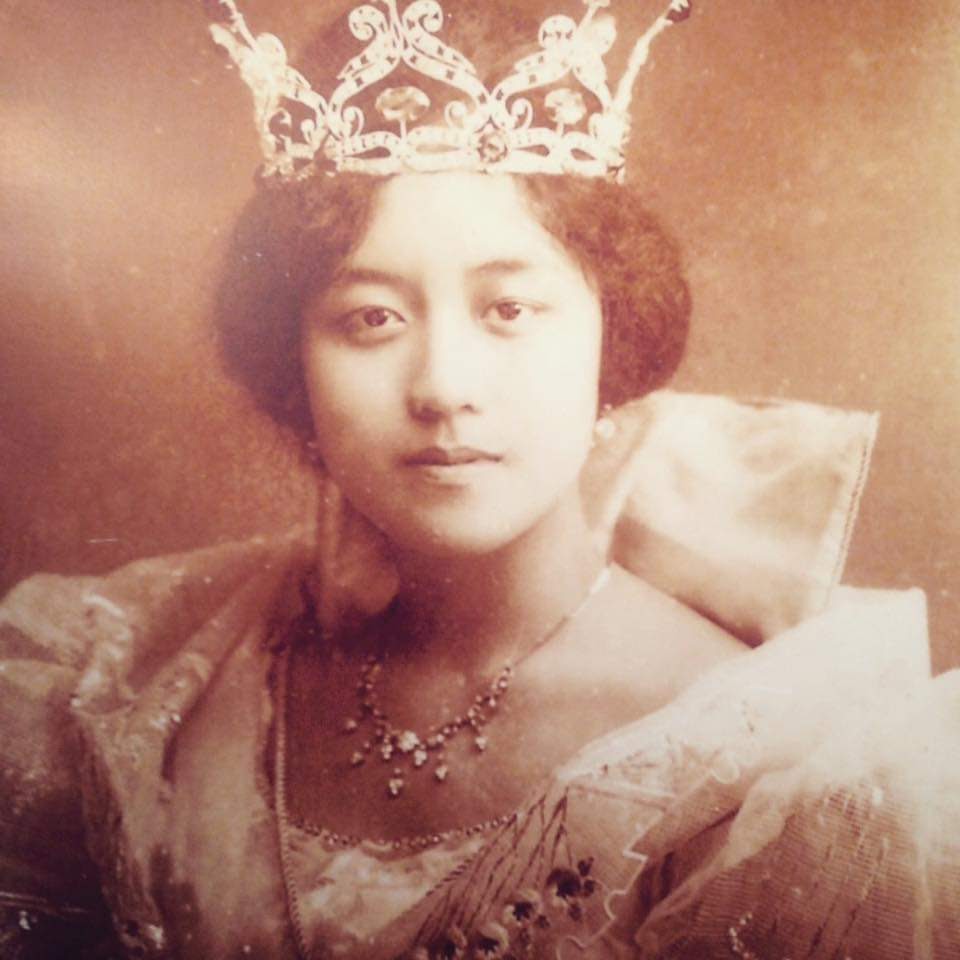
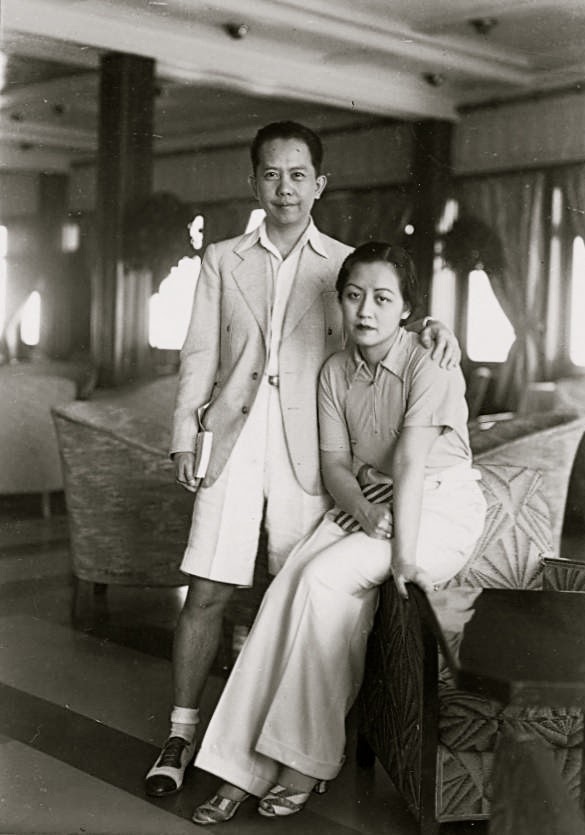
Right – Virginia and her husband Carlos P. Romulo from the Romulo Cafe website.
In every Carnival Queen, there is also a King of Consort. For Virginia, her King of Consort was handpicked by the management of the Herald, named Carlos P. Romulo from Camiling, Tarlac and the head editor of the said newspaper. At first, Carlos was unwilling to take the position as her King of Consort. At that time, he was still mourning for the death of his father and he also had a girlfriend. He also hated the idea of wearing a costume for the coronation; it was the big boss of their newspaper who made him comply. However, at the time of the coronation festival, he left Virginia multiple times to dance with other partners. During the last day, he decided to ask the Queen for a dance.
After two years of Virginia’s Carnival Coronation, they both fell in love with each other. She and Carlos got married on July 1, 1924 in Pagsanjan, making her the first Carnival Queen in the history to marry her King of Consort.
In 1961, Virginia was awarded a Presidential award for her “womanly virtues of a devoted wife and mother, the guardian of home and family values, and traditions and modesty.” She died on January 22, 1968 at the age of 67. At the time of her death, she was recognized as a one of the greatest Filipino women of modern times.
Socorro Henson – The Last “Original” Carnival Queen, 1926
Socorro Henson y Borcena was the first Kapampangan to be a beauty queen. She was only 19 years old when she was crowned as the last Carnival Queen in 1926. Socorro was born on August 29, 1907 in Angeles, Pampanga to Jose Bartolome Henson; a pharmacist that owned a drugstore inside Intramuros and Ercanacion Martinez Borcena which was a Spanish mestiza.
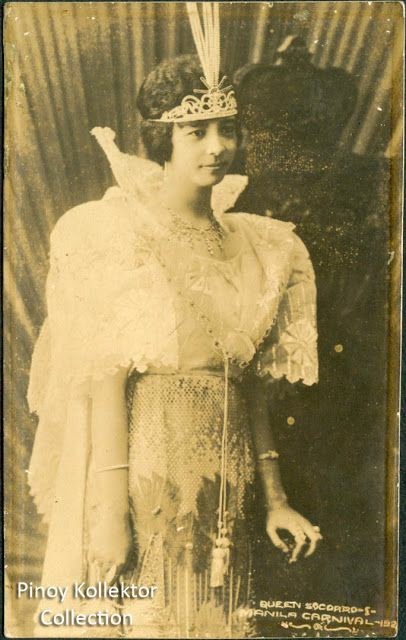
During the period of judging, Socorro had a strong competitor which was also a Kapampangan, named Lourdes Luciano y Magdangal. However, Lourdes gave way for Socorro for the title. She also won because of her regal and quiet beauty. Her brother, Col. Antonio Henson described her skin as “translucent, where you can see her delicate veins.”
After announcing that she won the title, their proud neighbors decorated the Solana Street in Intramuros to celebrate her win. They also made use of an Arabic inspired theme for the parade, where they had to ride an elephant while parading around the auditorium.
Socorro’s King Consort was Vincente Rufino. However, unlike Virginia Llamas who married her King Consort, Socorro married a consort of one of her court maidens. He was Francisco Limjap y Escolar, from an influential clan in Manila. They got married two years after the coronation of Socorro, on January 26, 1928. Even though she was married, she was able to finish a degree in Home Economics, while being a mother to four children. She died on February 26, 1976 from throat cancer months after her first child died.
Anita Noble – The First Miss Philippines, 1926
Anita Noble y Agoncillo was the first ever Miss Philippines. She was only 20 years old at the time of her coronation in 1926; the same year that Socorro Henson won her title. She was born on July 26, 1905 in Lemery, Batangas to Leoncio Noble and Maria Agoncillo who came from the influential clan of Agoncillo. Her mother was directly related to Maria, who was the second wife of Emilio Aguinaldo, Marcela, who was one of the makers of the Philippine Flag, and Felipe, who was a patriot of the first Philippine Republic.
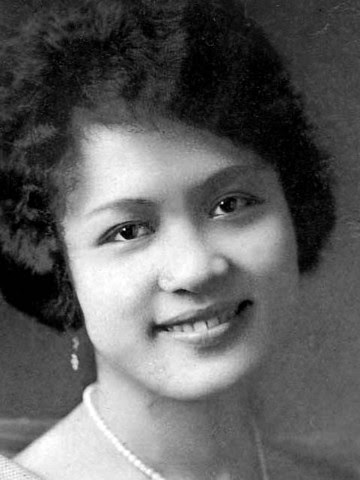
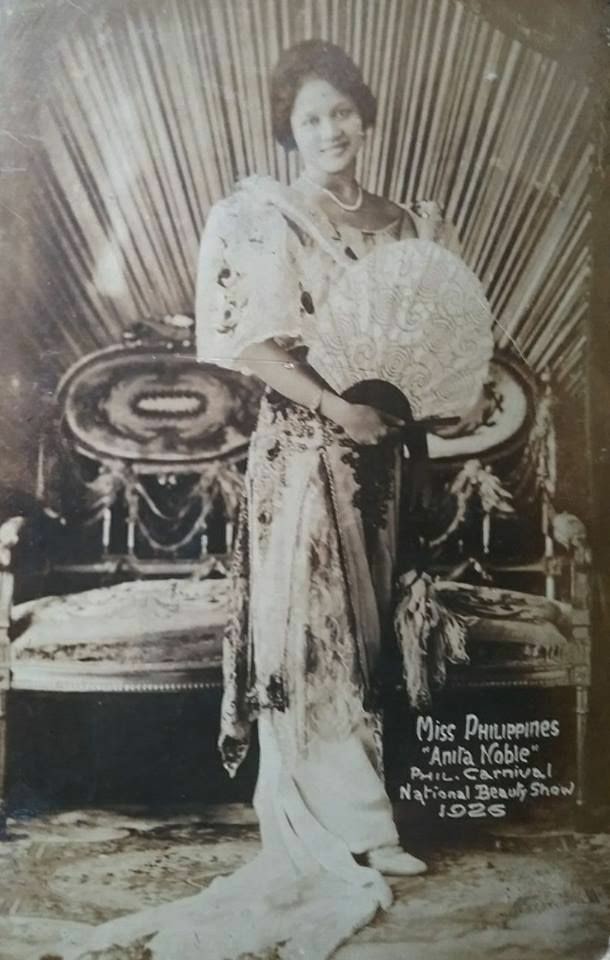
Many approved the Miss Philippines Pageant when it was first launched and they quickly formed their own pageants in their municipalities to find their candidate. However, this was not the case for Anita. Batangas at that time did not hold any pageant to find their candidate. She was handpicked by their governor, thinking she could be the perfect candidate for their province, to which no one disagreed. Anita held the Miss Batangas title and was sent to the national pageant immediately.
On selecting the winner, it was easy for the judges to choose the titles for Miss Luzon, Miss Visayas, and Miss Mindanao. However, they struggled to choose the winner for the Miss Philippines. It was a tight competition between Anita and Carmen Fargas from Zamboanga, where a tiebreaker was deemed a draw. Then President Manuel Quezon helped in deciding the winner for the title by inviting them to the Manila Hotel to eat lunch the next day. He also asked them to just wear simple baro’t saya and with no makeup, and then took into consideration how the ladies ate during lunch. After that, Anita was declared the first Miss Philippines. Then they created another title for Miss Zamboanga as the Miss Pearl of the Orient Seas as she was also a strong contender for the title. Anita not only became the first Miss Philippines; she also became the second Batangueña to win in the Manila Carnival after 10 years.
When Anita was proclaimed the winner for the Miss Philippines, everyone during that time deemed that it was the liveliest and most successful coronation in the history of the Carnival, where large number of people went to the Carnival auditorium to watch her take her throne and the dancing reached up to 5:00 am in the morning. Her King Consort was Leopoldo Kahn.
After the coronation, Anita became popular and many suitors went to Lemery, Batangas just to court her. On January 9, 1927 she met Juan Nakpil, an architect and the eldest child of Julio Nakpil and Gregoria De Jesus. Juan knew about Anita through newspaper clippings when she won the Miss Philippines. He finally met her during the Feast of Nazarene in Quiapo. From then, every Sunday he would visit Anita in Lemery to woo and court her. After a year, he won Anita’s heart and they married each other on December 10, 1927 with the reception held in the house of the governor of Batangas. Their love resulted in 5 children, where later both of her daughters also became beauty queens; Annie became Miss Batangas and Edith became Miss Philippines in the 1955 Carnival held in Boys’ Town.
By 1973, Juan Nakpil became the First National Artist for Architecture. After a few years, our First Miss Philippines died because of cancer on August 14, 1979.
Article written by Aly Garcia (@aly.pptx) . Art by Eysee (@arteysitic).
Renacimiento Manila. All rights reserved.
Join our #CarnavalMNL festivities this February! Be featured at Renacimiento Manila by sharing with us your artworks or artistic shots of Manila.
References
- Beta People Pill (n.d). Pura Villanueva Kalaw.
- Castro, Alex (2007, June 24). Views From the Pampang.
- Castro, Alex (2008, December 14). Manila Carnivals 1908-32: A Pictorial History of the “Greatest Annual Event in the Orient”.
- Castro, Alex (2009, January 21). Manila Carnivals 1908-32: A Pictorial History of the “Greatest Annual Even in the Orient”.
- Castro, Alex (2009, January 27). Manila Carnivals 1908-32: A Pictorial History of the “Greatest Annual Even in the Orient”
- Rodriguez, Mia (2020, October 26). The First “Miss Philippines” Was Also an Ilongga.
- Taal.ph (2013, October 3). The First Miss Philippines (1926).
- Silvestre, Jojo (2020, December 16). Women We Admire Pura Villanueva Kalaw Beauty Queen and Women’s Rights Pioneer.
- The Central Echo (2013) Hero Me, Hero Not via Issuu

The Renacimiento Movement. What, then, is the Renacimiento Movement? The movement is the core philosophy of the organization. It is founded on the reality that heritage is a cornerstone of holistic development and that it is indispensable in ensuring quality of life. As such, cultural revival is necessary for the promotion of heritage in the national agenda. Heritage should be driven by the people, regardless of race, gender, creed, or religion. This cultural revival can be achieved through the following ways: government support, the advancement of private initiatives, and the engagement of the people.


 Renacimiento Manila
Leave a reply to Colorful Sisters Cancel reply