
Ken Tatlonghari
28 March 2021
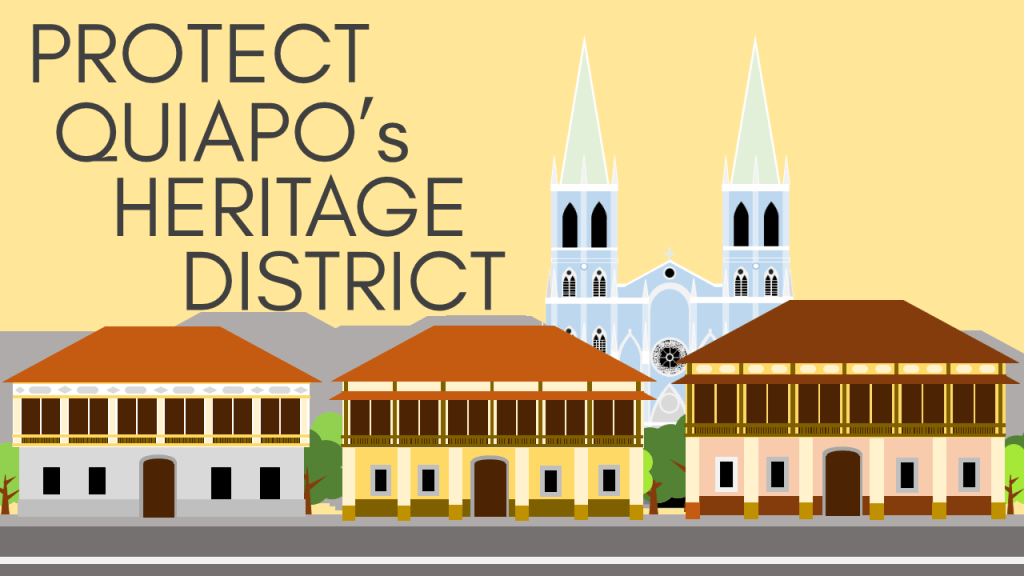
In our quest to turn Quiapo into a heritage zone which includes the illustrious San Sebastian Cathedral and R. Hidalgo as a heritage street, three Quiapo heritage houses are featured in the article as well as the historical figures associated with them –the Paterno and Zamora houses, and the Ocampo Pagoda. These buildings can be appreciated as they are still standing, and if they are hopefully restored then we would be showing Manila’s true character — one filled with arts and culture despite the adversity it faces…
1.

The Paterno ancestral house is associated with the controversial Pedro Paterno, as well as his sister Dolores who composed the song “La Flor de Manila” a.k.a “Sampaguita”. They were two of thirteen children by Maximo Molo Agustin Paterno and Carmina de Vera Ignacio, who belonged to the Chinese mestizo families of Paterno, Molo and Agustin.
Their sisters and stepsisters Agueda, Jacoba, Paz, Concepcion, and Adelaida were painters and jewelers whose exhibited their works at the Exposición Regional de Filipinas in Manila (1895) and the St. Louis World’s Fair(1904). They were also related to the painter Justiniano Asuncion.
As for Dolores who showed musical potential at an early age, she was educated at Santa Isabel College while spending much of her time studying piano. At the age of 25, she composed her one and only song inspired by the sampaguita flower, whose lyrics were written by her brother Pedro. Sadly, she would pass away two years later on July 3, 1881.
Her brother Pedro also produced creative works and he is credited with the first novel written by a native Filipino — Ninay (1885). He also authored the first Filipino collection of poems in Spanish, Sampaguitas y otras poesías varias (“Jasmines and Other Various Poems”).
He then became a political figure, being elected President of the Malolos Congress in September 1898 and serving as prime minister of the First Philippine Republic. But after the Philippine-American War, he pledged allegiance to the United States and this had plagued his reputation ever since.
2.

The Zamora House, which is right across from the Paterno House, is the ancestral house of Manuel A. Zamora, the chemist and pharmacist who invented the tiki-tiki formula to combat beriberi, a severe and chronic form of thiamine (vitamin B1) deficiency. He was the first to synthesize a stable version, which was then refined by Robert R. Williams, the American chemist who first isolated thiamine. The American colonial government then ordered the production of Tiki-Tiki as a health supplement for babies and it dramatically reduced the Philippines’ infant mortality rate. Manuel Zamora would have other contributions, but his life began on March 29, 1870 in Sta. Cruz, Manila as the son of Marciano Zamora and Martina Molo Agustin who belonged to Manila’s upper class.
He studied at the Ateneo Municipal during his formative years and then took up Pharmacy at the University of Santo Tomas. While studying, he became an apprentice in Botica de Quiapo, the old dispensary of Ocampo y Arevalo. Then in the university, he would garner awards for his research such as “Materia Farmaceutica Animal y Mineral” (1891-1892), and “Materia Farmaceutica Animal Vegetal” (1893-1894). His “Estudio Farmacologico de la Areca Cateru y Determinacion de Uno o Varios de sus Alkaloides” and “Purificacion de mil Granos del Acido Sulfurico del Comercio” earned him the licentiate in pharmacy, sobresaliente upon his graduation in 1896.

In 1901, Zamora first became catedratico auxiliary (assistant professor) in organic chemistry at UST, then he progressed to catedratico agregado (associate professor), and eventually he reached full professor status. He then put up his apothecary and a small laboratory at 928 R. Hidalgo Street in 1908, where he spent much of his time concocting the tiki-tiki. He also studied the nitrogen compound of patis and performed a comparative study of non-official Galenicals, like gotas amargas and aromatic vinegars commonly used in the Philippines in this lab.
At one point in his career, he was also part of the Board of Pharmaceutical Examiners. Then in 1921, the Centro Escolar University (CEU) opened its college of Pharmacy and Zamora was its first dean. He was also actively involved with scientific organizations like the Colegio Medico Farmaceutico, and the Philippine Pharmaceutical Association, which he helped set up in 1920.
Manuel Zamora accomplished a lot in his life and his list of pharmaceutical contributions include:
- Neurovia granulado Zamora,
- Vino yodo-tanico fosfatado Zamora,
- Vino estimulante nutritivo,
- Vino estimulante nutrivino con tiki-tiki Zamora,
- Gonorrema Zamora,
- Lustora,
- Alis galis,
- Mil flores pomade, and
- Elixir digestive estomacal.
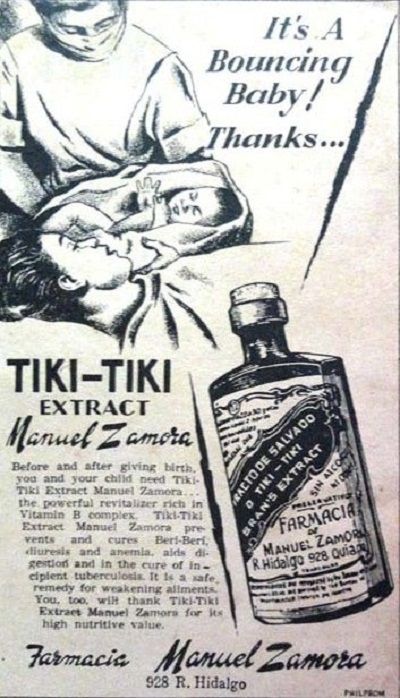
But his most outstanding achievement will always be the “tiki-tiki” extract — the local term for rice bran, which is the milling byproduct comprised of the seed coat and grain fragments, formulated in 1909. He was offered a good sum of money for the rights of his product by Parke Davis of New York, but he refused.
He would pass away at the age of 59 on July 9, 1929 as the husband of Baltazara Mangali and the father of Marciano and Felicidad Zamora.
3.
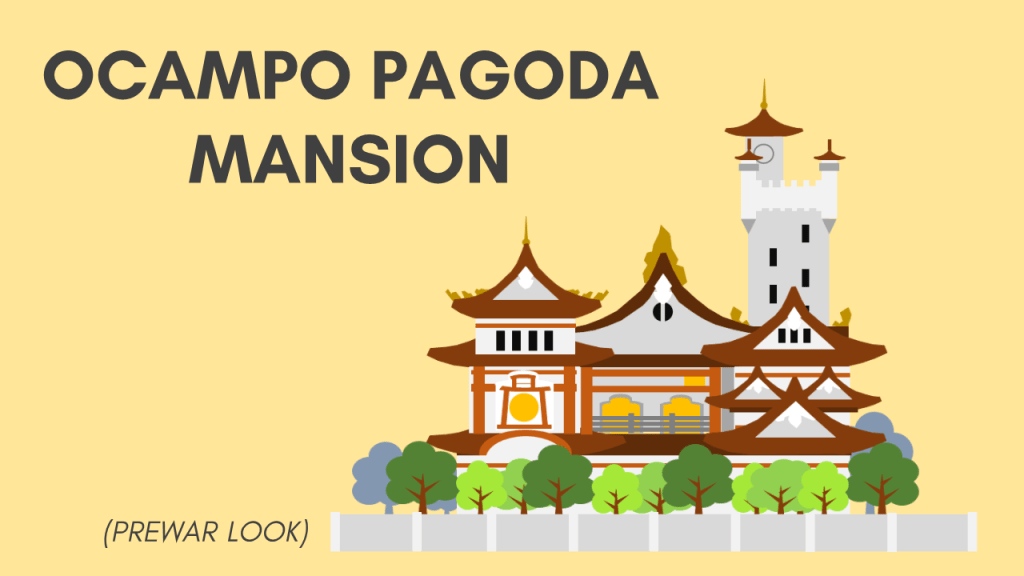
The Ocampo Pagoda can be reached by turning left on a narrow alley (Gonzalo Puyat St) on Bilibid Viejo St., if one starts from San Sebastian Cathedral walking towards Quezon Blvd. Don Jose Mariano Ocampo was the lawyer and realtor who had it built from 1936-1941 because of his admiration for Japan. Japan was able to equal and even surpass the West in some aspects in just a short span of time.
Although the building was Ocampo’s vision of a Japanese castle, it was also fused with Western elements. The upper part of its tower resembles a medieval Western castle and it is crowned by battlements with teeth-like projections and corbels below. The residence also contains many sculptures from the Christian faith.
But the mansion also has sculptures from Oriental culture such as the shachihoko or simply shachi, which is a mythical creature with the head of a tiger and the body of a carp. The creature was believed to have the power to induce rainfall and thus were often depicted in roof carvings of Japanese temples and castles as a protection from fires.

References
- Dolores Paterno via Wikipedia. Retrieved 28 March 2021
- Justiniano Asuncion via Facebook. Retrieved 28 March 2021
- Pedro Paterno via Wikipedia. Retrieved 28 March 2021
- Manuel Zamora via The Kahimyang Project. Retrieved 28 March 2021
- Manuel A. Zamora via Wikipedia. Retrieved 28 March 2021
- Pilipinas Retrostalgia. Retrieved 28 March 2021
- Collectors Connection. Retrieved 28 March 2021
- The hidden gems of Quiapo via The Urban Roamer. Retrieved 28 March 2021
- Ocampo Pagoda Mansion via Wikipedia. Retrieved 28 March 2021
- Onmark Productions. Retrieved 28 March 2021
Article by Ken Tatlonghari.
Cover art by Diego Torres.
Renacimiento Manila
All rights reserved.

The Renacimiento Movement. What, then, is the Renacimiento Movement? The movement is the core philosophy of the organization. It is founded on the reality that heritage is a cornerstone of holistic development and that it is indispensable in ensuring quality of life. As such, cultural revival is necessary for the promotion of heritage in the national agenda. Heritage should be driven by the people, regardless of race, gender, creed, or religion. This cultural revival can be achieved through the following ways: government support, the advancement of private initiatives, and the engagement of the people.

 Renacimiento Manila
Leave a reply to Gino Zamora Cancel reply