
June 9, 2026
Matthew Caudal & Sophia Gallardo
Renacimiento Manila
The Christian Brothers, otherwise known as the De La Salle Brothers, first arrived in Manila in 1911. As one of the major educational institutions that arrived along with the American occupation of the Philippines, it had the goal of re-establishing Catholic education among Filipinos in the City of Manila amidst a growing list of Protestant educators (Aluit, 1994). The Brothers then purchased a house on Calle Nozaleda in Paco, Manila where the first campus of the De La Salle College was established and welcomed its first students on June 16 (Philippine Lasallian Family, 2011). Most of De La Salle’s first students were American, German, and Spanish boys from the wealthier parts of Manila (Aluit, 1994), and the primary mode of instruction was English (DLSU, n.d.). The school continued to grow as more Brothers arrived as educators to accommodate the rising student population. Additionally, the City of Manila saw great developments under the American ideal as new commercial districts and parks, paved tree-lined roads, and great government buildings adorned with the very best of American architectural standards emerged from the North to the South of the Pasig River (Philippine Lasallian Family, 2011). De La Salle College followed suit and started development on a new and larger campus along Taft Avenue in 1921.
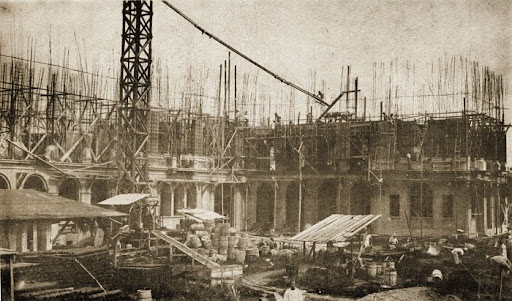
The new campus building boasted a commanding neoclassical facade in a clean white color, similar in style to the government buildings seen across the city at the time. The “H” shaped building found itself on the outermost reaches of Manila at the time of its construction as the city continued to grow and expand southward. Its three-storeys offered views of Manila Bay on one side and the sparse undeveloped lands of the Malate district on the other. A grand chapel in the Romanesque style was also constructed to house the religious activities of the Brothers, also resplendent in architectural features like chandeliers and wooden carvings across the pews and altarpieces (Aluit, 1994).
By the eve of the war in the 1940s, De La Salle College had grown into one of the country’s top educational institutions. It offered premium instruction in reading, writing, and arithmetic, emphasized discipline and Catholic values education, provided opportunities for athletics like soccer, track and field, and swimming and other extra-curriculars like debate, and offered degrees in Commerce and Business Administration, Engineering, and Accountancy for the next generation of leaders in the Philippines (Garcia, 2009 ; Gregorio, 2012).
LA SALLE DURING THE WAR
The De La Salle College held a High Mass in celebration of Our Lady of the Immaculate Conception when the first air sirens rang out announcing that war had reached the Philippine islands on that fateful Monday, December 8, 1941 (Garcia, 2009). As the Japanese air raids battered the city by targeting key military centers and air strips, collateral damage was high and injuries within the city increased which overwhelmed nearby medical centers, prompting the College to be a temporary refuge and hospital (Aluit, 1994). Following the flight of the American High Command under Douglas MacArthur from Corregidor, Manila was declared an open city (Scott, 2018). The Japanese seized the La Salle campus and stationed its Southern Manila Defense Headquarters in the building, allowing the Brothers to remain in its Southern wing, while some were interned at the Sto. Tomas Camp further north (Aluit, 1994; Scott, 2018).
Throughout the occupation, Brother Egbert Xavier, the Head of the Congregation, proposed to the Japanese High Command that education must continue. Through his efforts, the school resumed teaching by mid-1942 and operated in a smaller capacity from the grade school, high school, and collegiate levels amidst the uncertainties of the war (Garcia, 2009). Religious activities and catechesis continued in the campus while the addition of Japanese classes were mandated by the government and administered by Brother Maximin Maria (Jimenez, 2012; Garcia, 2009). The Brothers remained steadfast in their commitment to service and aid amidst the injured and displaced from the war while also emboldened by their religious zeal and devotion to respond to the the spiritual needs of increasingly despondent Filipinos (Scott, 2018; Garcia, 2009; Philippine Lasallian Family, 2011).
Toward the start of 1944, the Brothers actively provided refuge and shelter to the Filipinos made homeless by Japanese forces occupying, raiding, and burning swathes of homes along Ermita and Malate districts of Southern Manila (Scott, 2018, Philippine Lasallian Family, 2011). As news of allied victories in Europe reached Filipinos still at the stranglehold of the Rising Sun, hope was on the horizon but also the fear and uncertainty of a battle that would take place in the City of Manila; would the Japanese leave the Pearl of the Orient just as the Americans did in 1941, or will they dig in to a last stand that assures decimation of the Philippine capital (Scott, 2018).
THE BATTLE OF MANILA
The Japanese took the latter option and prepared for a final stand through the tight streets of metropolitan Manila (Scott, 2018). By February 1945, as the Battle of Manila raged across the city, De La Salle College had become a sanctuary for Lasallian Brothers, priests, employees, and civilian families alike seeking refuge from the air raids. On February 7, 1945, Japanese soldiers entered the campus and abducted Brother Xavier and is believed to have been tortured and killed after refusing to leave the campus. His disappearance was merely the start of a series of violent atrocities that would culminate in the massacre of Lasallian Brothers and civilian families finding refuge within the college grounds. On February 12 when Japanese soldiers stormed the campus and launched a brutal massacre inside the college and the Chapel of the Most Blessed Sacrament.
The attack was swift and indiscriminate, targeting all. Brothers, priests, servants, mothers, and children were bayoneted, shot, or left mortally wounded. Yet amid the violence, many of the Brothers chose not to flee but protected civilians, guided refugees to safety, and remained with the wounded. Brother Baptist de La Salle sacrificed his life while shielding a young boy from the attackers, while other Brothers attempted to negotiate with the soldiers or conceal those who could still be saved.
After killing and wounding their victims, the Japanese soldiers piled the dead and dying together before withdrawing temporarily. Survivors later recalled hearing laughter, drinking, and celebration outside the building while cries of pain echoed from within. The soldiers periodically
returned to inspect the premises, searching cabinets, closets, and hiding places for anyone still alive. They looted valuables from the victims and even stole sacred vessels from the chapel.
Throughout the night, the wounded struggled to survive among the dead, having to pretend to be one of the lifeless around the campus. Father Francis Cosgrave, himself severely injured, regained consciousness beneath a pile of bodies and crawled through the building to administer absolution and comfort to the dying. Other survivors gathered behind the altar and inside the sacristy, where they remained hidden as fighting continued around them.
Japanese troops then attempted to burn sections of the chapel, while artillery shells and explosions shook the campus as American forces advanced through Manila. Food and water became scarce. Those sheltering behind the altar survived on unconsecrated hosts and water collected from flower vases. Despite repeated searches, the Japanese never discovered many of the survivors concealed within the sacred spaces of the chapel.
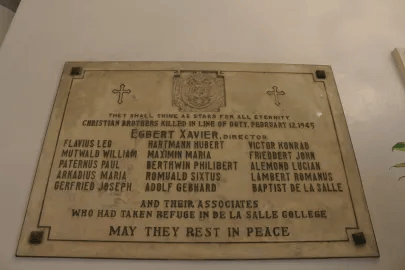
When the violence finally subsided and American forces arrived, 16 of the 17 De La Salle Brothers residing on campus had been killed, together with 25 civilians. The massacre remains one of the darkest chapters in De La Salle’s history and stands as a powerful testament to the courage, sacrifice, and faith displayed by the Lasallian community during the Battle of Manila.
POST-WAR
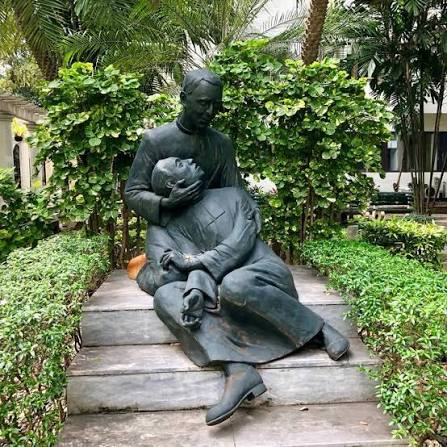
The sun refused to bow to gun fire and bayonets. It basked the bullet-ridden walls of Saint La Salle Hall, its warm light touching the cold bloodstained floors, revealing the nightmares endured by the institution once built of dreams. The month-long siege of the City of Manila ended only six days after the brutal attack of the Japanese forces against the refugees of the College (Aluit, 1994). With grief, the halls were cleaned and the chapel was restored with a marker commemorating the deaths of 16 Christian Brothers and 25 innocent civilians (Jimenez, 2012; Felicilda and Demeterio, 2020). Their last memory was Fr. Francis Cosgrave, CSsR, then chaplain of De La Salle College, bleeding, yet administering last rites and whispering absolution and blessing to the dying victims (Lagman, Jr., 2019; Jimenez, 2012) — the very image depicted on the memorial that is still standing at the Marian Quadrangle of Saint La Salle Hall until today.
EXPANSION OF COLLEGE AND GRADUATE STUDIES PROGRAMS
Their faith has been tested, their service has been upheld, and the Lasallian Brothers wasted no time to return to their communion. Four months after the brutal massacre, the primary and secondary levels resumed classes. A new four-year curriculum was introduced to the Commerce program in 1946, followed by Engineering in 1947, Arts and Sciences in 1953, and Education in 1959. They began offering graduate studies in Business Administration in 1963 and Education in 1966. For 30 years, De La Salle College remained to be the only serving La Salle branch in the Philippines. This period ended with the establishment of the second branch in Bacolod in 1952, marking the continuous and evolving pursuit of the Lasallian Brothers towards higher education (De La Salle University, n,d.; Gregorio, 2012; Philippine Lasallian Family, 2011).
PROGRESSIVE CHANGES
As the nation slowly progressed in the 1960s, students found their voices through activism. Several La Sallites rose and fought against US imperialism, elitism, fair tuition fee increase, students rights, and academic freedom. In 1969, the first Student Council election was held, with the elected president representing the student body in the Board of Trustees (ex-officio) and Academic Council and various committees. The College also established the Development Office to widen the student aid programs. In 1970, the Textbook Writing Committee was formed to publish accurate and concise works discussing Filipino values, Aesthetics, Biology, Chemistry, Economics, English, and Philosophy. The Committee also strengthened their bilingual education program by incorporating a series of Pilipino Manuals into Social Studies and publishing an English series, way ahead of the government’s promulgation of the National Bilingual Education Policy of 1974. From then on, the concept of “tripartite academic community” evolved to conduct respectful consensus between the students and the faculty in policies and decision-making (Jimenez, 2014).
With the emergence of the Women’s Liberation Movement in the West, the De La Salle College became a co-educational institution in 1973, opening its doors to the Primas, its first 38 female students (De La Salle University, n,d.; Gregorio, 2012). Just after two decades, their population would grow to constitute half of the student body (De La Salle University, n,d.). The rallying of students toward progressive advocacies and protection of human rights did not end within its campus. When Martial Law (1972 – 1896) declared journalism as an ally and a foe, the government seized and shut down several newspaper and broadcast outlets, while some only remained to release sanitized and censored news to aid the administration’s agenda. Still, the search for truth gave birth to alternative presses, which articles combated censorship and echoed dissenting voices. Student publications became a part of the alternate press in the 1980s, including the LaSallian De La Salle College publication. Many alumni also actively participated in resistance movements and were pursued by military forces for their activist works (Cruzada, 2022).
PROMOTION TO UNIVERSITY
At the midst of the chaos, the De La Salle College was officially elevated into a university on February 19, 1975 (De La Salle University, n.d.; Gregorio, 2012). The growing population of the now De La Salle University resulted in the foundation of the De La Salle Santiago Zobel School in Muntinlupa on March 29, 1978. The primary and secondary departments were transferred to the new branch, leaving the Taft campus to solely focus on higher education by 1983 (De La Salle Santiago Zobel School, n,d.). The University opened new departments, including the College of Career Development for working professionals in 1980. The night school was renamed as De La Salle University – College of Saint Benilde eight years later, marking the establishment of the DLSU System. It became independent by 1994 and officially dropped the “University” from its name by 2004 (De La Salle College of Saint Benilde, n,d.)
The wake of the Marcos Regime in the 1980s brought the Philippine economy to its worst recession in history with a national debt of $24.4 billion in 1982 (Solon and Floro, 1993). In response, the University implemented a trimestral system in 1981 (De La Salle University, n,d.; Gregorio, 2012). The same year marked the establishment of the College of Computer Studies, while the College of Arts and Sciences was reorganized the next year into two separate units: the College of Liberal Arts and the College of Science. The economic recession did not halt the growing student population of the University which grew from around 3,000 to about 10,000 by the end of the decade (De La Salle University, n,d.). After leaving the National Collegiate Athletic Association (NCAA) in 1981, the University was granted admission to the University Athletic Association of the Philippines (UAAP) in 1986 (De La Salle University, n,d.), where they continue to reign over today, winning a total of 18 basketball championship titles and 13 UAAP titles by the Women’s Volleyball Team.
In the 1990s, DLSU strengthened its status as a research-oriented institution by forming a faculty with doctoral degrees, investing in its development, and increasing research funding. As part of its centennial preparations, the Philippine Lasallian community developed the Lasallian Guiding Principles (LGPs) in 2003, which served as the predecessor of the Lasallian Pedagogical Framework (LPF) and the Lasallian Core Curriculum (LCC) in 2004. In 2008, the Expected Lasallian Graduate Attributes (ELGAs) was introduced to define the competencies and values Lasallian graduates must have. The College of Law was established in 2009, while the College of Business and Economics was divided into the College of Business and the School of Economics, reflecting the University’s commitment to social responsibility and nation-building through protection of human rights and enhancing public policy development.
Remaining faithful to the mission of its founder, the University continued to champion excellence in education while expanding opportunities for underserved sectors of society. To support this commitment, the institution provides a range of scholarship and financial assistance programs for students with economic needs, as well as those who demonstrate outstanding academic achievement at both the undergraduate and graduate levels. These include the St. La Salle Financial Assistance Grant (De La Salle University, n,d.), the Star Scholarship Program (De La Salle University, 2026), and the Vaugirard Scholarship Program (Vines, 2024; Department of Education, 2011), among other scholarship initiatives.
FACILITIES
As the College evolved into a University and the various De La Salle institutions across the Philippines were eventually unified into a system, Saint La Salle Hall continued to stand as the University’s most recognizable landmark and enduring symbol of its history and identity. Despite its rich architectural heritage, the University has had to balance the preservation of its historic identity with the demands of urban development and institutional growth. In the 1980s, the construction of the LRT Line 1 improved accessibility to the campus, but partially obscured the visual prominence of the iconic Saint La Salle Hall from Taft Avenue. To accommodate the growing student population and provide a venue for major events, the Marilen Gaerlan Conservatory was erected in 1998 within the hall’s courtyard, concealing much of its neoclassical façade (Felicilda and Demeterio, 2020).
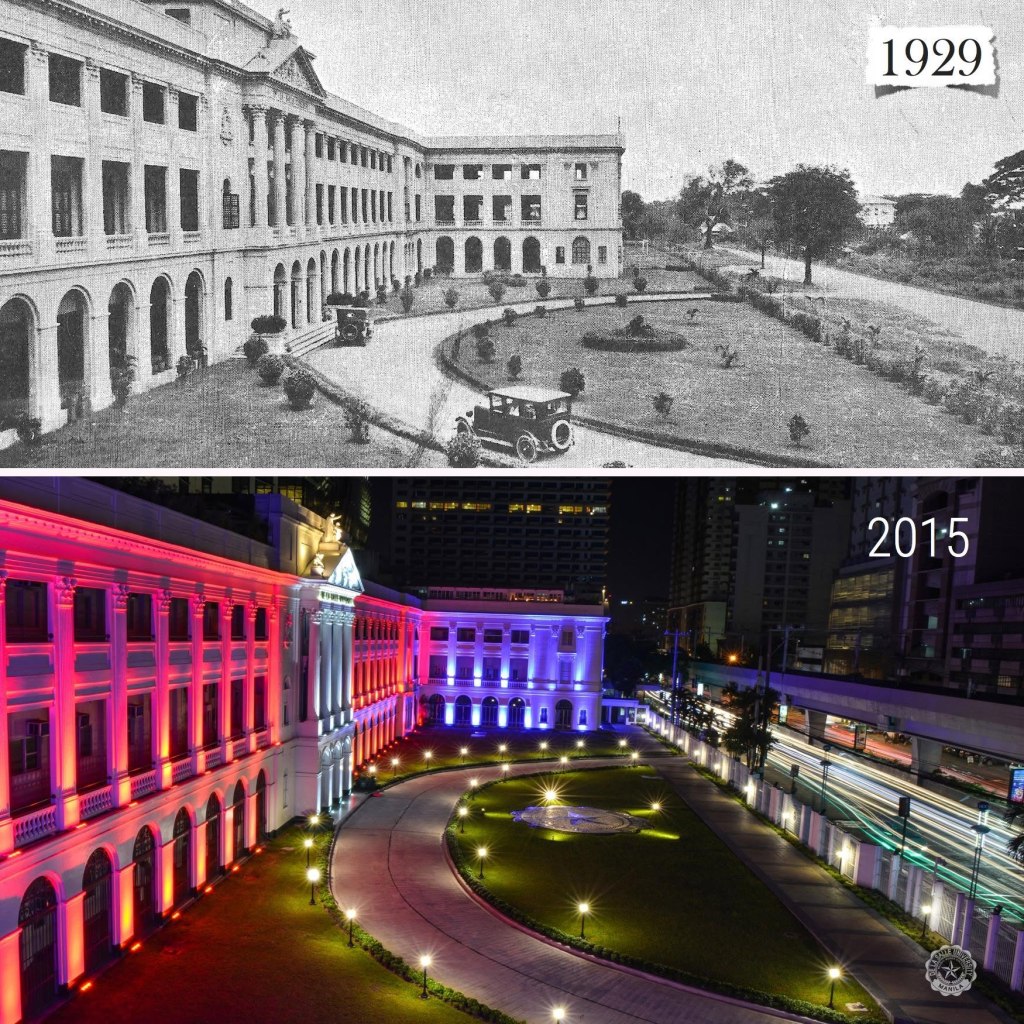
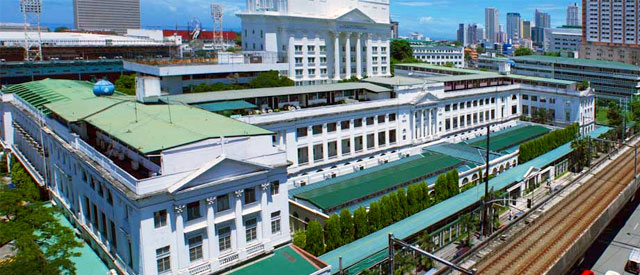
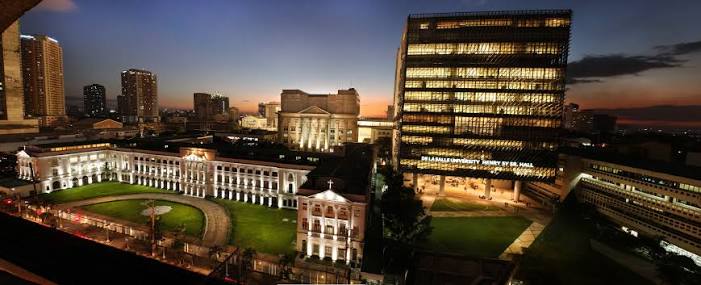
Recognizing the need to preserve the University’s architectural heritage while supporting future expansion, the Manila campus master plan was reassessed in 2010 by a team of renowned architects, including Augusto Villalon, Leandro Locsin Jr., and Leon Mayo. Their recommendations led to a comprehensive campus redevelopment program that resulted in the demolition of the conservatory and the restoration of Saint La Salle Hall’s original façade, driveway, ornamental ironwork, and landscape features in 2014. The historic structure also underwent structural retrofitting to ensure its long-term preservation and safety (Felicilda and Demeterio, 2020).
As part of the campus transformation, the former football field was redeveloped into the Corazon Aquino Democratic Space. Complementing the restored Beaux-Arts character of Saint La Salle Hall, a contemporary academic building was constructed adjacent to it to house the University Library, Learning Commons, Registrar, audio-visual facilities, and administrative offices. This modern structure was named after its principal benefactor, Henry Sy Sr., founder of SM Supermalls (Digital De La Salle, n,d.).
This year, De La Salle University celebrates its 115th year, a testament to more than a century of educational excellence, resilience, and service. What began in 1911 as a modest institution with only 100 male students (Gregorio, 2012; De La Salle University, n,d.; Philippine Lasallian Family, 2011) has grown into a leading university serving approximately 26,747 students of diverse backgrounds (De La Salle University, n,d.). Throughout its history, the University has weathered significant national and global challenges, including the devastation of World War II, the political upheavals of the Martial Law era, and periods of economic uncertainty, while continuously adapting to the demands of a rapidly urbanizing society.
Over the decades, DLSU has produced distinguished alumni who have made significant contributions across various fields, including government, business, the arts, entertainment, science, and public service. More importantly, the University’s enduring legacy lies in its steadfast commitment to the educational mission of the Lasallian Brothers: providing quality, values-oriented education that is both transformative and socially responsive. Guided by its Catholic faith and Lasallian traditions, De La Salle University continues to nurture intellectually competent, morally grounded, and socially responsible individuals, aspiring to form future leaders who will contribute meaningfully to the development of the nation and the welfare of its people.
REFERENCES
- Aluit, A. J. (1994). “By sword and fire: The destruction of Manila in World War II, 3 February–3 March 1945”. National Commission for Culture and the Arts.
- Anonymous. (n.d.). “De La Salle-College of Saint Benilde”. Bionity. https://www.bionity.com/en/encyclopedia/De_La_Salle-College_of_Saint_Benilde.html
- Cruzada, D. B. (2022). “The Lasallian in the face of repression: A history of Lasallian student publications during martial law (1972–1986)”. Animo Repository. https://animorepository.dlsu.edu.ph/etdb_history/15
- De La Salle Santiago Zobel School. (n.d.). “History”. https://www.dlszobel.edu.ph/index.php/new-to-dlsz/the-zobel-legacy/formation/
- De La Salle University. (n.d.). “History & timeline”. Retrieved June 9, 2026, from https://www.dlsu.edu.ph/history-and-timeline/
- Felicilda, J. M. B., & Demeterio, F. P. A. (2020). Ang Bulwagang San La Salle: Pakikipanayam sa apat na dalubhasa nitong sentenaryo ng paglatag ng cornerstone ng nasabing pamanang estruktura ng Pamantasang De La Salle Maynila. “Malay, 32″(2), Article 9. https://doi.org/10.59588/2243-7851.1093
- Garcia, J. L. (2009). “It took four years for the rising sun to set (1941–1945): Recollections of an unforgettable ordeal”. De La Salle University Press.
- Gregorio, F. S. (2012, September 4). “De La Salle University (1911–2011)”. National Historical Commission of the Philippines. https://nhcp.gov.ph/de-la-salle-university/
- Jimenez, J. D. (2012). “The martyrdom at De La Salle College during the Japanese occupation of the Philippines”. “Manila, 8″(1).
- Jimenez, J. V. (2014). “The first sparks of student activism at De La Salle College, 1968–1972”. Scribd. https://www.scribd.com/document/428569492/Student-activism
- Lagman Jr., O. (2019, February 12). “A horrible day never to be forgotten”. Inquirer Opinion. https://opinion.inquirer.net/119491/a-horrible-day-never-to-be-forgotten
- Philippine Lasallian Family. (2011). “History”. Internet Archive Wayback Machine. https://web.archive.org/web/20110810133846/http://100years.lasallian.ph/history
- Scott, J. M. (2018). “Rampage: MacArthur, Yamashita, and the Battle of Manila”. W. W. Norton & Company.
- Solon, O., & Floro, M. (1993). “The Philippines in the 1980s: A review of national and urban level economic reforms”. World Bank. https://documents1.worldbank.org/curated/en/876031468915271942/pdf/The-Philippines-in-the-1980s-a-review-of-national-and-urban-level-economic-reforms.pdf


Leave a Reply